

A single battery change per device in a large building can wipe out the entire profit margin of a maintenance contract. If you are planning or installing commercial smart home switches, you know the challenge: hundreds of units must function reliably without a team constantly having to change batteries. The complexity of retrofitting and the conflict between technical function and aesthetic design unnecessarily slow down many projects.
You are looking for a solution that simply works and stays in the background. In this article, you will learn how battery-free smart home technology revolutionizes efficiency in commercial properties through kinetic energy harvesting. We will show you how to meet the strict EU requirements of the EPBD by 2026 while drastically reducing installation times per unit. We will look at maintenance-free solutions in the Gira System 55 design, which combine technical excellence with minimalist aesthetics and secure your ROI in the long term by eliminating service calls.
Key Takeaways
- Discover why software-controlled lighting systems will become the standard for energy efficiency and flexibility in commercial buildings by 2026.
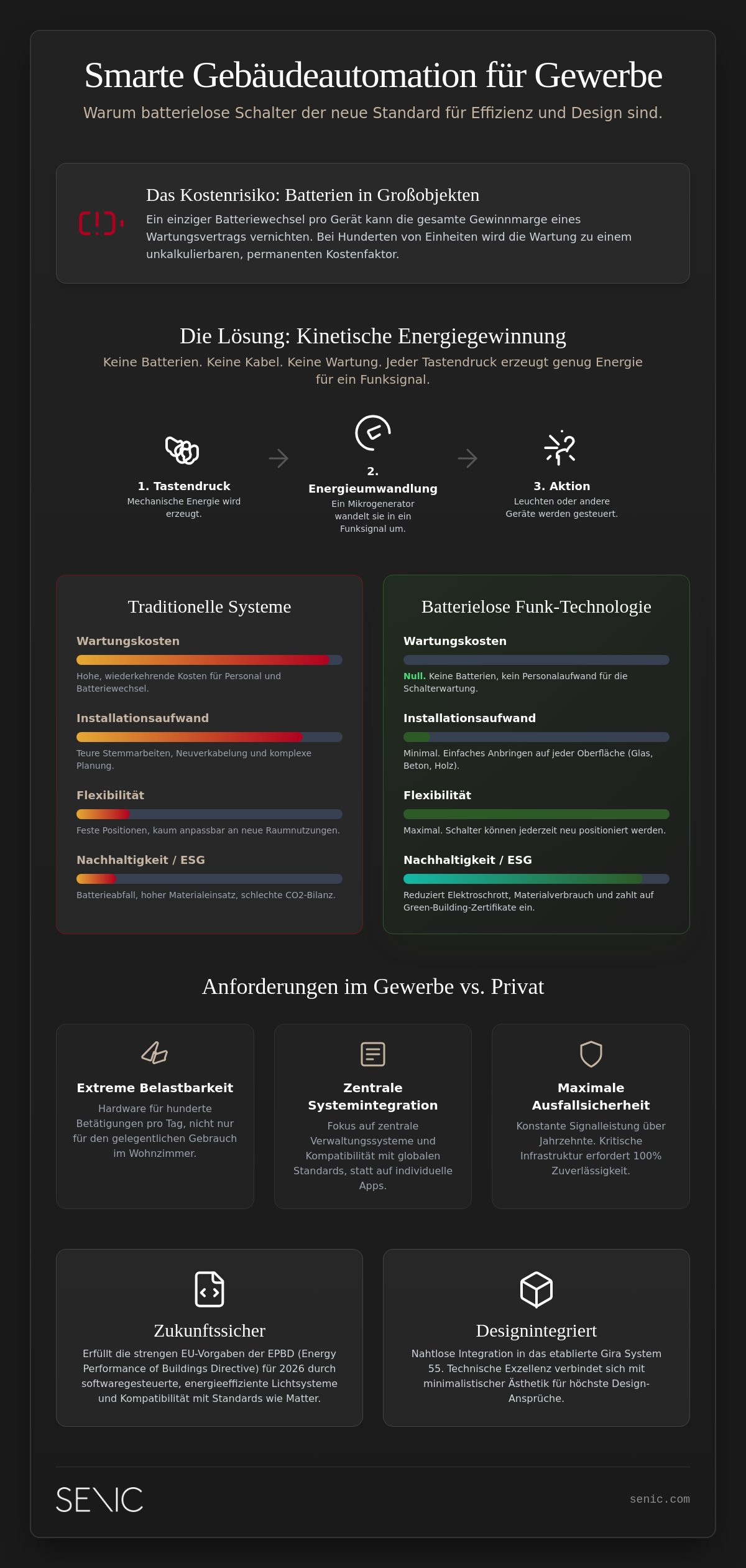
- Learn how kinetic energy harvesting completely eliminates battery changes and reduces maintenance costs in large properties to zero.
- Analyze the savings potential in installation, as wireless solutions eliminate expensive chasing work and complex rewiring.
- Use commercial smart home switches for industry-specific requirements, from flexible lighting zones in the office to wireless control in the hospitality sector.
- Maintain the highest design standards through seamless integration of smart switch technology into the established Gira System 55.
The Evolution of Commercial Lighting Control by 2026
The architecture of commercial properties is undergoing a fundamental transformation. Rigid electrical installations and fixed floor plans are a thing of the past. Modern buildings now function like software. They are modular, adaptable, and responsive. In this environment, modern building automation takes over the central control of all trades. A crucial element of this development is the commercial smart home switch, which serves as an interface between the user and complex technology. It is no longer just an accessory, but a strategic tool for energy management.
By 2026, lighting control in businesses will be fully digitized. The goal is maximum efficiency. Traditional switch solutions reach their limits here. They require complex wiring and offer no flexibility for room changes. Radio-based systems solve this problem, but in the professional sector, many standard solutions fail due to maintenance. Battery changes for hundreds of switching points are not economically viable. The solution lies in self-sufficient systems that do not require an external power source. The hardware must last. Every day. Thousands of times.
Commercial vs. Private Smart Home Requirements
In the private sector, a smart switch is often a gadget. In a commercial environment, it is a critical component. The frequency of use is many times higher. While a light switch in the living room might be pressed ten times a day, in an office or hotel, it happens hundreds of times. The hardware requires enormous mechanical resilience. Another difference is management. Commercial solutions rely on central systems rather than individual apps. Security and reliability are paramount. A system failure in a public building has fatal consequences. Professional reliability is required here.
Sustainability and ESG Standards in Modern Construction
Sustainability is not a trend, but a regulatory obligation. Companies must meet ESG (Environmental, Social, Governance) criteria to remain competitive. Battery-free technologies play a key role in this. They reduce electronic waste and eliminate toxic substances from the building cycle. A commercial smart home switch that uses kinetic energy directly contributes to certifications like DGNB or LEED. It saves CO2 by eliminating batteries and minimizes material consumption during installation. Precise scene management also ensures that energy is only consumed where it is actually needed. This conserves resources and permanently reduces operating costs.
- Maintenance-free: No costs for battery changes or personnel expenses.
- Flexibility: Placement on glass, concrete, or wood without chasing.
- Design Consistency: Integration into high-quality switch programs such as the Gira System 55.
- Future-proof: Compatibility with global standards such as Matter and Apple HomeKit.
The hardware requirements are clearly defined. Robustness meets minimalist design. Durability meets simplest installation. Those who invest in commercial properties today rely on technology that works invisibly in the background and reliably for decades.
Why Battery-Free Technology Forms the Backbone of Commercial Smart Homes
In large properties, scalability is the decisive criterion for success. A system that requires regular manual intervention is prone to errors and uneconomical. Batteries in this context are a systematic weakness. They discharge unevenly and generate special waste. Above all, they tie up valuable personnel resources for trivial maintenance tasks. Kinetic technology radically solves this problem. For the use of commercial smart home switches, being maintenance-free is not a luxury, but an economic necessity.
The reliability of commercial networks depends on the constancy of their components. While conventional wireless switches lose signal strength with decreasing battery voltage, the performance of kinetic switches remains constant for decades. No signal loss. No delay. Just reliable function with every button press. This consistency forms the basis for a smooth user experience in modern work environments.
The Functionality of Kinetic Switches in Detail
The principle behind this autonomy is called energy harvesting. With every actuation of the switch, mechanical pressure is converted into electrical energy. A tiny electrodynamic energy converter generates enough electricity to send an encrypted radio signal. It is a closed, self-sufficient system. No cables. No batteries. The signal is stable and easily penetrates solid walls or metal structures in modern office complexes. Since these commercial smart home switches rely on standards like Zigbee, they can be seamlessly integrated into ecosystems like Philips Hue or Apple HomeKit.
Elimination of Maintenance Cycles in Large Properties
Efficiency begins with ongoing operation. Commercial buildings harbor enormous energy saving potentials, which often remain unused due to inefficient control. However, intelligent lighting control must not drive up operating costs (OPEX) through hidden maintenance expenses. A single battery change, including travel, personnel time, and documentation, incurs costs that quickly exceed the purchase price of the device. With 500 switches in a property, this effort adds up to hundreds of working hours per cycle.
Kinetic switches completely eliminate this cost block. They are tested for hundreds of thousands of switching cycles. This means absolute reliability without service intervals. In addition, they make a measurable contribution to sustainability. Industry statistics for battery-free wireless technologies show that by June 2026, over 1.7 million tons of CO2 could be saved by eliminating batteries. For specialist planners, Senic offers specialized switches for installers that are precisely tailored to these maintenance-free requirements in large projects.
The mounting flexibility rounds off the profile. Glass walls in conference rooms or exposed concrete in lobbies are often insurmountable obstacles for classic switches. Kinetic wireless switches are simply glued on. This saves time during initial installation and protects the building structure. If rooms are redivided or work zones are changed, the switch simply moves with them, without drilling or new cables.
Economic Analysis: Installation Costs vs. Long-Term Maintenance
The economic viability of a building is decided by details that are often underestimated during planning. Anyone planning a commercial smart home switch today must think beyond the pure purchase price. The true savings lie in reducing the Total Cost of Ownership (TCO). Conventional, wired systems cause enormous initial costs. Market analyses for 2026 show that the costs for a complete KNX installation in new buildings often range between 35,000 and 70,000 euros. In existing buildings, these sums often increase by another 20 to 40 percent due to the effort of retrofitting.
A wireless retrofit offers a decisive financial leverage here. The biggest cost factor in conventional installations is the labor time for milling wall chases and laying copper cables. Battery-free wireless switches halve the installation time per unit. They are simply glued where they are needed. This allows renovations during ongoing operations. Downtime, which means direct revenue losses in hotels or offices, is thus reduced to an absolute minimum. Installation is clean, quiet, and dust-free.
Reducing Capital Expenditures (CAPEX)
The elimination of flush-mounted boxes and complex cable routing saves material and skilled labor hours. Every saved box reduces the risk of errors during the construction phase. Pre-configured sets enable quick and intuitive commissioning. Those who pay attention to installation costs will find the most efficient solution for modern architecture here. A detailed comparison shows how you can implement smart home switches without installation costs and gain wireless freedom for your projects. This is particularly relevant as the EU Buildings Directive (EPBD) mandates the installation of building automation systems in many non-residential buildings by May 2026.
Optimizing Operating Expenses (OPEX)
In the long term, being maintenance-free determines profitability. Conventional wireless systems hide their costs in battery replacement cycles. In a property with hundreds of switching points, battery management becomes a logistical nightmare. Kinetic switches incur zero costs here. There are no batteries to buy or dispose of. There is no personnel running through the building checking devices. The system is self-sufficient.
Especially in new work environments, flexibility plays a central role. Office layouts change frequently today. With a kinetic commercial smart home switch, you can adapt lighting control to new team structures within minutes. You can move switches to glass walls or furniture without structural interventions. This scalability without additional infrastructure investments secures the ROI over a period of 10 years. The system grows with the company's requirements without creating new cost holes. It is an investment in stability and functional excellence.
Implementation in Various Industries: Office, Hospitality, and Retail
Every industry places specific demands on building automation. A commercial smart home switch must function differently in a hotel lobby than in a sterile hospital corridor or a dynamic co-working space. Scalability is the common denominator here. In projects with hundreds of switching points, easy implementation determines project success. Battery-free wireless technology offers the necessary flexibility to meet the individual needs of users without overloading the infrastructure.
Smart Office: Lighting Control for the Hybrid Working World
In modern offices, the fixed assignment of desks is a thing of the past. Hybrid work models require lighting that adapts to the actual occupancy. Intelligent switches can be seamlessly integrated into booking systems. If an employee appears in the office, a button press activates their personalized light scene. If they leave the area, the system automatically switches to energy-saving mode. This precise control increases comfort and simultaneously reduces energy consumption. Since the switches are simply glued to glass walls or mobile partitions, companies remain completely flexible when rearranging rooms. No new cables. No dust.
Hospitality: Guest Experience through Intuitive Technology
In the hotel industry, user experience comes first. Guests are often overwhelmed by complex touch panels with countless menus. Haptic switches offer familiar, intuitive operation here. Especially when renovating historic hotel buildings, wireless solutions show their strengths. Valuable building fabric remains untouched, as no chases need to be cut for bed wiring. A smart bedside switch is simply mounted to the headboard of the bed. Learn more about why professional smart home switches lead the wireless revolution in Gira design.
Retail and public spaces also benefit from this robustness. In sales rooms, employees centrally control accent lighting wirelessly to optimally showcase products. In public buildings, vandalism protection is crucial. Kinetic switches score here with their mechanical durability and the lack of easily accessible battery compartments. They are built to last. For planners and architects, Senic offers specialized solutions for commercial projects that combine technical expertise with the highest design quality.
Senic for Professionals: Seamless Integration into the Gira System 55
In commercial architecture, aesthetic uniformity is not an end in itself. It is an expression of quality and durability. The Gira System 55 has established itself as the gold standard over decades. Senic uses this ecosystem to elevate the commercial smart home switch to a new level. It's about the perfect symbiosis of proven frame design and forward-looking, battery-free wireless technology. Planners no longer have to choose between technical innovation and design fidelity. Both merge into a single unit.
The acceptance of new technologies in offices or hotels depends on usability. A switch must feel like a switch. It must not appear out of place. By using the original Gira form factors, the visual appearance throughout the building remains consistent. Smart components are visually indistinguishable from conventional inserts. This creates trust with the user and peace in the room design.
Aesthetics Meets High Technology
Consistency is crucial for a professional impression. Senic switches are available in standard colors such as pure white or anthracite. They blend seamlessly into existing installations. The user feels no difference to classic systems when operating them. The haptic feedback is precise. A familiar click confirms every switching operation. This attention to detail distinguishes professional solutions from generic retrofit modules. For large projects, smart home switch wholesale offers specialized packages. These ensure availability and economic efficiency when equipping entire building complexes.
Advantages for Electrical Contractors
Time is the scarcest resource in skilled trades. Installing a Senic switch often takes only a few minutes. No boxes need to be drilled, and no cables need to be pulled. For professional businesses, this means more projects in less time. Another advantage is the drastic reduction in warranty claims. Since the technology is battery-free, service calls due to dead batteries are completely eliminated. The system is maintenance-free and extremely durable.
- Easy configuration: Quick integration into Philips Hue or Apple HomeKit ecosystems.
- Future-proof: An update for the Gira System 55, planned for September 2026, will bring extended functions such as Siri voice control and widgets.
- Competitive advantage: The enormous time savings during installation is a strong argument in every tender.
- Professional bundles: Multi-packs for installers optimize logistics on the construction site.
The combination of kinetic energy and the Gira System 55 makes the smart home switch for commercial use an indispensable component for modern properties. It is a solution that eases the burden on installers and delights end customers with reliability. Those who choose Senic today are investing in technology that remains invisible and simply works.
Future-Proof Building Automation: Efficiency Without Compromise
Modern commercial properties will be measured by their maintenance-free operation and flexibility in 2026. Battery-free kinetic technology forms the crucial foundation for this. It eliminates follow-up costs for battery changes and saves valuable personnel resources in large-scale projects. The seamless integration into the Gira System 55 also ensures that technical progress does not impair the aesthetic quality of the architecture. Those who plan a smart home switch for commercial use today are opting for a solution that adapts to dynamic work environments without structural effort.
Senic supports specialist planners and installers with specialized support and optimized bundles in the implementation of demanding projects. This cooperation ensures quick commissioning and lasting reliability for decades. It's time for a technology that works perfectly without demanding attention. Rely on durability and maximum efficiency in your future real estate projects.
Discover Senic solutions for commercial projects
Frequently asked questions about commercial lighting control
Are battery-free smart home switches robust enough for continuous commercial use?
Yes, battery-free switches are extremely durable and tested for over 100,000 switching cycles. The kinetic energy generation works with low mechanical wear. It is specially designed for the high frequency of use in offices, hotels, or public buildings. Since no batteries can age or leak, the switching performance remains constant and reliable for decades.
How many switches can be operated simultaneously in a commercial network?
In a standard setup with a Philips Hue Bridge, about 25 to 30 switches can be operated stably, in addition to other luminaires. For larger projects with a high number of smart home switches for commercial use units, several bridges or professional gateways are combined. This modular structure allows for almost unlimited scalability for entire office floors or hotel complexes.
Can Senic switches be integrated into existing Gira E2 or Standard 55 frames?
Yes, the switches are fully compatible with the Gira System 55. They fit exactly into the frames of the E2, Standard 55, Esprit, and Event series. This allows planners to combine smart technology and conventional sockets in a uniform design. The visual integrity of the commercial interior architecture is thus fully preserved.
What is the range of kinetic switches in buildings with reinforced concrete walls?
The radio range indoors is about 30 meters. While massive reinforced concrete walls can dampen the signal, the Zigbee protocol used solves this problem through mesh technology. Each permanently installed smart luminaire acts as a repeater and forwards the signal. This ensures seamless signal coverage even in extensive commercial properties.
How much time is saved during installation compared to wired systems?
Installation is about 50% faster than with conventional systems. Since no wall channels need to be milled and no new cables need to be laid, time-consuming preparatory work is eliminated. The switches are simply glued to the desired surface or screwed onto existing flush-mounted boxes. This allows commissioning within a few minutes per unit.
Do commercial users need special software for managing the switches?
No, management is done via established platforms such as Philips Hue or Apple HomeKit. These apps already offer all the necessary functions for grouping lamps and managing lighting scenes. For professional users, handling is intuitive and does not require lengthy training in complex proprietary building management systems.
What happens to the configuration of the wireless switches during a power outage?
The configuration is absolutely secure, as all settings are stored in the bridge or gateway. No data is lost during a power outage. Once power is restored, the system automatically reconnects. The kinetic switches are immediately ready for use again, without any manual intervention or re-learning.
Are there special conditions or bulk packages for commercial customers?
Yes, Senic offers specialized packages for professional customers, such as the Double or Triple Indoor Pack. These "Switches for Installers" are priced optimally for use in large-scale projects. In addition, installers and planners receive dedicated support to find the best technical solution for their specific commercial requirements.

0 comments