

A smart home is only truly smart if it requires no maintenance and integrates invisibly into your living space. Many homeowners want to retrofit their smart home without cables but are deterred by the thought of chiselled walls or the frustration of empty batteries in wireless switches. Nobody wants visible surface-mounted cables or exorbitant installation costs for technology that demands constant attention.
We share your preference for minimalist design and functional excellence. In this 2026 guide, you'll discover how to transform your home into a modern system that operates completely without battery changes and blends seamlessly with your existing aesthetic. It's about true autonomy through kinetic energy and uncomplicated self-assembly that instantly enhances your living value. This way, your home remains aesthetically and technically up-to-date.
We take a look at the latest developments, such as the Matter 1.6 standard, and show you how to create a durable solution with maintenance-free switches. Learn how technology works perfectly without ever having to pick up a screwdriver for a battery change again. Since maintenance-free concepts will shape the trends of 2026 in many areas, visit Vapes Australia to learn more about innovative lifestyle products.
Key Takeaways
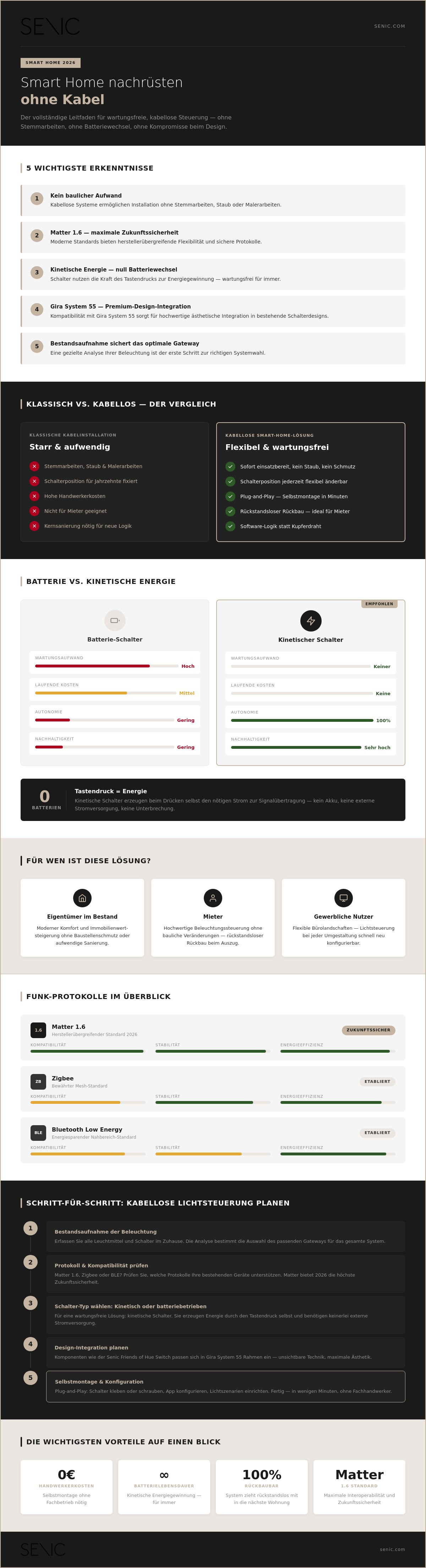
- Wireless systems enable efficient installation without structural effort or dust generation.
- When retrofitting a smart home without cables, modern standards like Matter 1.6 offer maximum flexibility and future-proofing.
- Kinetic switches use button-press energy, eliminating battery changes and ongoing maintenance.
- Compatibility with the Gira System 55 allows for high-quality technical integration into your existing switch design.
- A targeted inventory of your lighting ensures the selection of the optimal gateway for your entire home.
Retrofitting Smart Home Without Cables: Why Wireless is the Future of Renovation
Retrofitting a smart home without cables today means much more than just eliminating physical wires. It's the intelligent integration of modern control technology into existing living structures without affecting the building fabric. Anyone renovating in Germany knows the problem: every new cable involves extensive chiselling work, dust generation, and subsequent painting. Wireless systems completely eliminate this process. The devices are ready for immediate use. They offer a technical sovereignty that was previously only achievable through a complete core renovation.
The technological functionality of wireless light switches has massively evolved by 2026. While earlier wireless solutions occasionally struggled with range issues, current standards guarantee a stability that is in no way inferior to classic cable connections. This development is a decisive argument, especially for tenants. Since the components are usually only glued or screwed, a residue-free removal is possible at any time when moving out. The capital invested in one's own smart home infrastructure is thus preserved and simply moves with you to the next apartment.
Cost-efficiency plays a central role in the decision. Savings result not only from the elimination of expensive installation materials. Above all, the reduction in labor hours significantly relieves the budget. Plug-and-play solutions make it possible to configure complex lighting scenarios or controls yourself within minutes. This makes the project of retrofitting a smart home without cables an economically attractive option for any modernization project.
Challenges of Classic Electrical Installations
Classic installations are rigid. Once laid, cable routes fix the position of a light switch for decades. Especially in old buildings in Germany, planning changeover switches is often associated with disproportionate effort. In 2026, wireless systems solve these problems with software logic instead of copper wire. Reliability is ensured by modern mesh networks and protocols such as Matter 1.6, which effectively minimize interference.
Target Groups for Wireless Retrofitting
- Existing Homeowners: They seek modern comfort and increased property value but shy away from the dirt and disruption of a construction site.
- Tenants: This group wants to professionally control high-quality lighting systems like Philips Hue without having to consult with the landlord about structural changes.
- Commercial Users: In modern office landscapes or hospitality, spaces need to remain flexible. While wireless switches simplify lighting control, businesses in the UK hospitality sector, for example, rely on Shift4 POS UK to optimize their operations through modern cloud technology.
This flexibility ensures that technology no longer hinders space design. It becomes an invisible companion that adapts to the needs of users instead of restricting them.
The Technology Behind Wireless Switches: From Radio Waves to Kinetic Energy
The technical implementation determines whether a system will impress in the long term or become a maintenance trap. Those who want to retrofit a smart home without cables often encounter battery-powered solutions. These initially seem inexpensive, but over the years, they cause significant maintenance effort. Technological progress in 2026 now allows us to completely do without batteries. Instead, we rely on autonomy through innovative energy generation directly at the switch.
Modern wireless smart home technologies use various protocols to transmit signals securely. Zigbee and Bluetooth Low Energy (BLE) are established standards, while Matter 1.6 revolutionizes cross-manufacturer communication. These standards are so energy-efficient that the minimal force of a button press is sufficient to send a command. This makes the system independent of external power sources or permanently installed batteries.
A key aspect of reliability is signal range. In modern smart homes, devices permanently connected to the power grid, such as smart lamps, act as signal amplifiers. This so-called mesh network relays commands from switch to switch. This way, your control signals reach even remote corners of the house without the need for additional repeaters.
How Kinetic Energy Works
Inside these switches, an electrodynamic energy generator operates. As soon as you press the button, it converts mechanical pressure into electrical energy. This brief electrical impulse is sufficient to generate a digital radio signal and send it to the gateway. It's a maintenance-free principle that is not only practical but also avoids valuable special waste from used batteries. This form of technology works invisibly and guarantees a lifetime of readiness for use.
Compatibility with Ecosystems
Integration into existing systems usually takes place via a bridge that acts as a translator. Whether Philips Hue or Apple HomeKit; modern kinetic switches can be seamlessly integrated. By supporting current protocols, your installation remains future-proof. You can control complex lighting scenarios or entire routines with a single click, without ever having to open an app. For an aesthetically pleasing solution, high-quality indoor switch packs are available that perfectly combine technology and design.
This technological maturity ensures that the installation remains invisible. You focus on the experience, while the hardware reliably performs its service in the background. After all, a smart home should simplify your everyday life, not burden it with regular battery changes.
Battery vs. Batteryless: Why Maintenance-Free Makes a Difference
Choosing a wireless system is the first step towards more living comfort. But those who want to retrofit a smart home without cables face a second, often underestimated choice: Do I use battery-powered switches or do I rely on maintenance-free kinetic energy? Many standard solutions on the market rely on coin cells like the CR2450. What initially seems uncomplicated develops over the years into a hidden burden for time and environment. True technological excellence only shows itself when a system functions for decades without intervention.
The advantages of batteryless technology go far beyond mere convenience. While battery contacts can corrode over time and reduce reliability, a kinetic system remains mechanically precise. In addition, the absence of a battery compartment allows for a significantly flatter design. Batteryless switches appear more elegant and cling more closely to the wall. The result is an aesthetic that does not impose itself as a subsequent installation but appears seamless.
The ecological aspect is more relevant than ever in 2026. Every avoided battery reduces the amount of special waste generated. An average household with ten smart switches would consume about 30 to 50 batteries over a ten-year lifespan. Kinetic solutions eliminate this waste entirely. They use the already available energy of your button press and thus make your home a bit more sustainable.
The Hidden Effort of Battery Solutions
Smart technology should simplify everyday life, not create new to-do lists. The biggest problem with battery solutions is unpredictable failure. Usually, the switch stops responding exactly when it's least convenient; for example, late at night in a dark hallway. In addition to the frustration factor, the cost of special batteries over a decade adds up to an amount that often negates the initial savings in purchase price. A maintenance-free system, on the other hand, offers the certainty that every click reliably triggers a command.
Kinetic Switches in Design Check
A high-quality smart home is characterized by its seamless integration into the existing architecture. Our kinetic switches are optimized for the renowned Gira System 55. This means for you: full compatibility with a variety of frames and surfaces. The haptics impress with a defined, mechanical click that gives you immediate feedback. Whether in matte black, pure white, or other variants; the material quality meets the highest demands and enhances any interior. Thus, the project of retrofitting a smart home without cables becomes a design statement.
Technology should be invisible and work perfectly. With batteryless switches, you choose a solution that can simply be forgotten after installation. There are no flashing warning lights for low battery levels and no need to keep spare parts on hand. It is the purest form of home automation.
Step-by-Step: How to Plan Your Wireless Lighting Control
Successful modernization begins with precise planning. If you want to retrofit your smart home without cables, you should first take stock of your premises. Identify all light sources that you want to control intelligently in the future. As a rule, you will need a gateway for central management, such as the Philips Hue Bridge. This acts as a hub between your switches and the light sources. Configuration is conveniently done via an app. Here you can set individual light scenes or define precise dimming settings for different times of the day.
Physical installation is incredibly simple. Since no cables need to be laid, the use of a drill is completely eliminated. The switches can be flexibly glued or screwed onto existing flush-mounted boxes. This makes the system ideal for rental apartments in Germany, as the original condition of the property can be restored at any time. You gain full control over your environment without leaving permanent traces on the building structure.
Finding the Ideal Position
Free yourself from the limitations of classic electrical installations. Place switches exactly where they are intuitively needed. Mount a control directly next to the bed or on glass walls where wiring would be impossible. In the hallway, the walking path can be optimized with additional switching points, so you never have to search for the switch in the dark again. You can find more valuable tips in our guide for wireless smart lighting control.
Avoiding Mistakes During Retrofitting
A common mistake is simply gluing over old wall switches. Instead, make sure that the smart light sources are continuously supplied with power. If the physical circuit is interrupted by the old switch, the lamp remains "offline" and does not react to wireless commands. Also, test the wireless range at the desired position before permanently fixing the switch. Solid concrete walls or metallic surfaces can dampen the signal. A quick test saves time and ensures smooth operation from the start.
Start your project with a solid foundation. For an introduction to a maintenance-free system, we recommend a high-quality Single Indoor Switch that perfectly blends into your existing design. This way, you immediately experience the difference a well-thought-out, wireless solution makes in everyday life.
Senic Friends of Hue: The Invisible Revolution for Your Home
The Senic Friends of Hue switches mark the current pinnacle of wireless building control. Those who want to retrofit their smart home without cables often look for a solution that combines technical superiority with timeless design. Our Kinetic Switches have been developed precisely for this requirement. They do not function as a mere gadget, but as an integral element of your architecture. Setup is incredibly simple. In less than two minutes, the switch is paired via the Philips Hue app and immediately ready for use. It's technology that adapts to your pace.
A decisive advantage is the close partnership with Gira. By using the Gira System 55 format, we guarantee a uniform appearance throughout your home. The switches seamlessly integrate into existing frame programs. This ensures a visual calm that is often lost with many retrofit solutions. You don't have to choose between modern intelligence and classic elegance. We offer you both in a maintenance-free package.
Sustainability at Senic is not a marketing term, but a technical foundation. A switch from us is a purchase for life. Since no batteries are required, not a single gram of toxic battery waste is produced over the entire service life. The system is self-sufficient and conserves valuable resources, while at the same time offering you the maximum convenience of modern lighting control. It is the consistent implementation of a philosophy based on longevity and efficiency.
Design Meets Technology
Our switches are available in various colors to perfectly harmonize with your individual interior. Whether it's matte black for modern accents or classic pure white, the material quality is tangibly perceptible. The Senic Single Indoor Switch offers wireless perfection in the smallest space. It's no coincidence that professionals and architects worldwide rely on this battery-free solution. They appreciate the freedom of placement and the certainty that the technology will function precisely even after decades. If you want to retrofit your smart home without cables, this switch is the first choice for sophisticated living concepts.
Future-Proof with Apple HomeKit and Hue
The Friends of Hue certification guarantees native and stable integration into your existing ecosystem. You not only control individual lights but also access complex scenes or entire groups with a single press of a button. Cross-manufacturer routines can also be created via Apple HomeKit. For example, a click when leaving the house not only turns off the lights but also lowers the heating or activates the security system. This interoperability makes your home ready for tomorrow's demands, without having to lay new cables today.
Smart technology should enrich your daily life without making it more complicated. With Senic's kinetic solutions, you choose an invisible revolution that harmonizes perfection and simplicity.
The Future of Your Home is Wireless and Maintenance-Free
True innovation means that technology serves you, not the other way around. You now know that kinetic energy finally eliminates annoying battery changes. Aesthetic integration into the proven Gira System 55 preserves the visual tranquility of your living spaces. Anyone who wants to retrofit their smart home without cables chooses a solution today that combines technical sovereignty with sustainable autonomy. It is an investment in durable quality and daily comfort, completely without construction dust or high installation costs.
Our switches are officially Friends of Hue certified and are handcrafted with the highest precision in Germany. We guarantee you a system that seamlessly integrates into your life and remains there permanently. Experience the freedom of control that is placed exactly where you intuitively need it. It's time for technology that works perfectly, without ever again demanding your attention for maintenance.
Discover Senic's wireless switches in the shop
Transform your living space into an intelligent refuge today. Your modern home awaits you.
Frequently Asked Questions about Wireless Retrofitting
Can I install smart home switches myself without cables?
Yes, installation is easy thanks to the included adhesive pads or simple screwing, without the need for specialized personnel. Since the switches are not connected to the power grid, there is no safety risk from electrical voltage. Setup is intuitive via the corresponding gateway app. This makes the project of retrofitting a smart home without cables an ideal project for DIY enthusiasts and tenants.
How long does a kinetic switch last without a battery?
A kinetic switch is designed for a lifespan of several decades and is almost maintenance-free. The internal mechanism is typically tested for over 100,000 switching cycles. With average use, this corresponds to an operating period of more than 20 years. Since no chemical batteries are installed, there are no aging processes due to leaking cells or capacity loss.
Do battery-free switches also work with Apple HomeKit?
Yes, battery-free switches with Friends of Hue certification can be fully integrated into Apple HomeKit. Communication takes place via the Philips Hue Bridge, which acts as an interface. Once paired, you can use the switch not only to control light sources but also to activate complex HomeKit scenes. This allows you to control thermostats, roller blinds, or security components with just one press of a button.
Do I have to remove my old switches for retrofitting?
No, removing the existing electrical installation is not necessary for using wireless systems. The new switches can be placed anywhere in the room, for example, on glass walls or directly next to the bed. It is only necessary to ensure that the smart lamps are permanently supplied with power. The old switches can either be retained or permanently bypassed with special covers.
What happens to my wireless switches in the event of a power outage?
In the event of a power outage, all configurations, scenes, and groupings remain securely stored in your gateway's memory. The wireless switches themselves function autonomously and do not require power. As soon as the power supply in the house is restored, the smart lamps automatically connect to the system. Your switches are immediately fully operational again without needing to be reconfigured.
How many lamps can I control with a single wireless switch?
With a single press of a button, entire groups or rooms comprising up to 50 light sources can be controlled. The limit here is primarily determined by the capacity of the gateway, not by the switch itself. You have the freedom to program individual lamps, zones, or the entire lighting of a floor to a single button and dim them precisely.
Are wireless switches safe from hacker attacks?
Wireless switches use highly secure, encrypted radio protocols such as Zigbee, which were specifically developed for building automation. Since the switches do not establish a direct internet connection but only communicate locally with the gateway, external access is almost impossible. The security of the overall system is ensured by regular, automatic security updates of the gateway and adherence to modern encryption standards.
Can I also use the switches outdoors?
Yes, for outdoor use, special models like the Single Outdoor Switch are available. These devices are robustly constructed and have appropriate IP certification for protection against splash water and weather influences. This allows you to control your garden or terrace lighting just as conveniently and maintenance-free as your indoor lighting, without having to drill through walls or lay underground cables.

0 comments