

Smart lighting should simplify your daily life, not create new maintenance tasks. A Philips Hue wireless switch is often the first choice for more convenience, but many users are bothered by cheap plastic looks or annoying battery changes after a few years. It's frustrating when the light doesn't respond just because the physical wall switch was accidentally pressed or the remote control is dead at the crucial moment.
You are looking for a solution that seamlessly integrates into your decor and works absolutely reliably. Today we show you how to perfectly control your Philips Hue system with wireless switches, without ever having to change batteries again. Thanks to innovative kinetic energy and high-quality materials, the technology in your home becomes almost invisible. In this overview, we look at the best battery-free solutions for 2026 that look and feel like classic light switches. Learn all about the easy installation over existing flush-mounted boxes and the seamless integration into the proven Gira System 55 design for an aesthetic smart home.
Key Takeaways
- Learn how kinetic energy eliminates the need for batteries and makes your lighting control permanently maintenance-free.
- Discover how to mount a wireless Philips Hue switch directly over your existing flush-mounted boxes without complicated rewiring.
- Understand the advantage of "Friends of Hue" certification for stable system integration and maximum functional reliability.
- Combine modern smart home with classic design through seamless compatibility with the Gira System 55 standard.
- Find the ideal solution for indoor and outdoor areas to control your entire home uniformly and intuitively.
Why a Philips Hue Wireless Switch is the Best Choice for Your Home
Smart lighting promises convenience. But the reality in everyday life often looks different. When you enter a room, you don't want to have to look for your smartphone or give a voice command. You want to press a switch. A Philips Hue wireless switch closes exactly this gap between modern technology and familiar haptics. It makes the system usable for every resident, whether tech enthusiast, guest or child.
The Philips Hue system is based on a stable radio connection. For this to work, the luminaires must be permanently supplied with power. Conventional wall switches are counterproductive here. They physically disconnect the connection. A wireless switch, on the other hand, controls the lamps digitally, while the power supply remains active. This ensures reliability and prevents error messages in the app.
Flexibility is another decisive factor. You can place the control where it is really needed. Right next to the sofa, on the bedside table or at child-friendly height. There are no fixed specifications due to the original electrical planning of your house.
The Problem with Classic Wall Switches
Smart lamps require a constant energy source to receive commands via Zigbee or Bluetooth. If someone turns off the classic light switch, the lamp is "unreachable". Automations no longer work. Schedules run into the void. The system loses its usefulness. A Philips Hue wireless switch solves this dilemma permanently. It takes control without interrupting the circuit. This keeps your smart lighting ready for use 24 hours a day.
Advantages of a Wireless Installation
The biggest advantage lies in simplicity. You don't have to knock out slots. No dust is generated. High electrician costs are completely eliminated. Installation is usually done with simple adhesive pads or screws directly on the wall or even on glass surfaces. This is particularly attractive if you want to retrofit your smart home without cables.
- Rental apartments: Removable without residue when moving out.
- Old buildings: No worries about brittle wiring or missing flush-mounted boxes.
- Design freedom: Placement independent of existing power outlets.
Thanks to wireless technology, your interior remains flexible. If the room layout changes, the switch simply moves with it. This independence makes the installation future-proof and stress-free.
Battery-Free Technology: How Kinetic Energy Revolutionizes Switches
Wireless freedom in a smart home often means a new dependence on batteries. A Philips Hue wireless switch based on kinetic energy breaks this cycle in an elegant way. It uses the pure power of your movement to activate lighting moods. This technology makes controlling your home autonomous and frees you from annoying maintenance intervals.
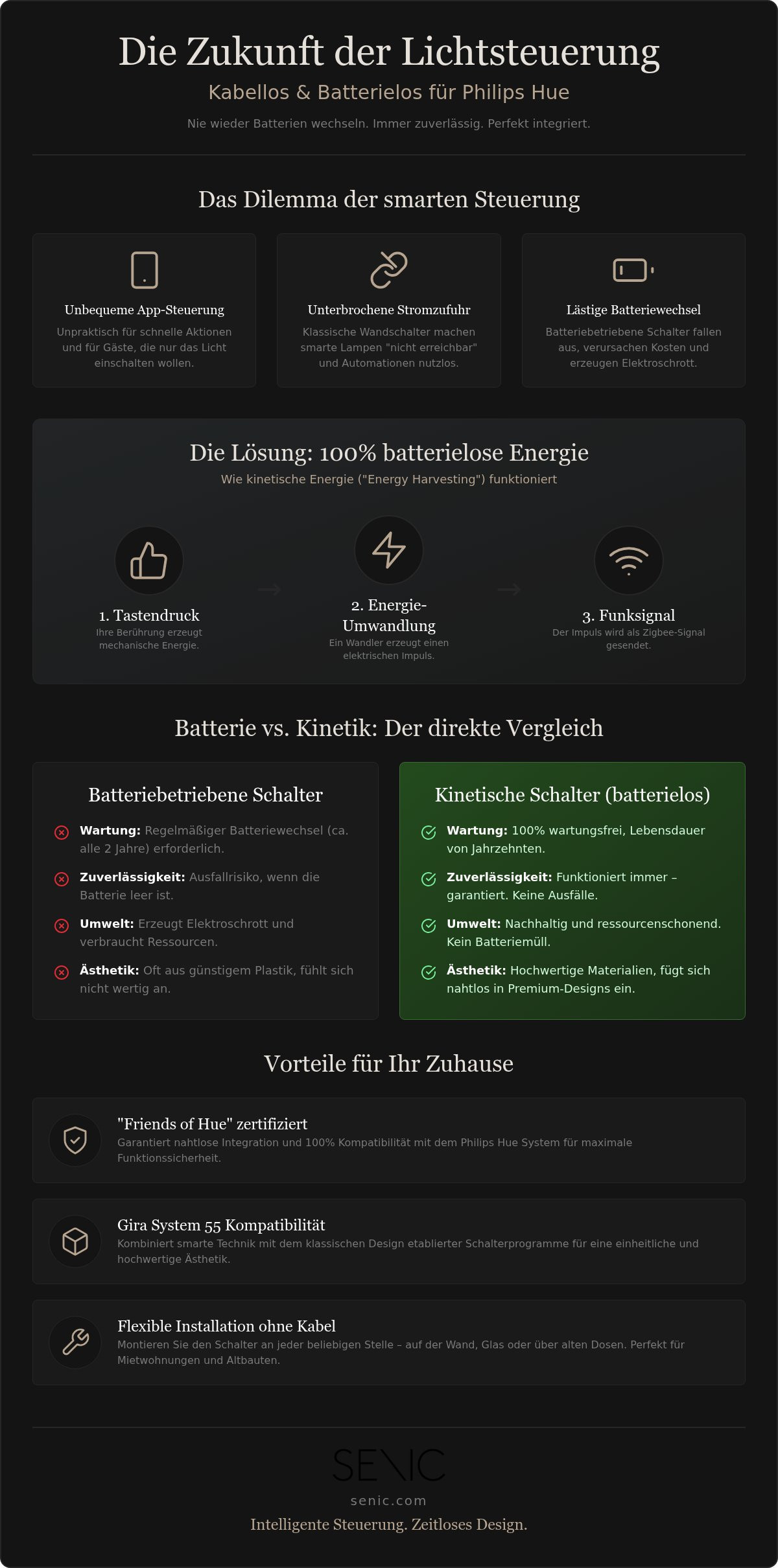
The core of this innovation is what is known as energy harvesting. Every button press generates a tiny but sufficient electrical impulse. This kinetic energy for switches is directly converted into a radio signal. It is technology that powers itself with every use. You install the switch once and never have to worry about the energy source again.
How the Battery-Free Radio Switch Works
Inside the housing is an electromechanical energy converter. As soon as you press the rocker, this component converts the mechanical pressure into electricity. An integrated Zigbee module uses this moment to immediately send the command to your Philips Hue Bridge. The transmission takes place in fractions of a second. In modern residential buildings, the signal reliably reaches distances of up to 30 meters, which is more than sufficient for most room concepts.
Comparison: Battery vs. Kinetics
Conventional radio switches usually use button cells, which, according to technical data, need to be changed approximately every two years. This not only incurs costs but also generates unnecessary electronic waste. Battery-free switches, on the other hand, are designed for an extremely high number of switching cycles. They often last for decades without losing signal strength. By eliminating chemical energy storage, you save significant costs in the long run and protect the environment from hazardous waste.
Sustainability is a central pillar in the modern smart home. Kinetic systems eliminate the risk of leaking batteries, which often destroy the internal electronics. This mechanical longevity makes maintenance-free solutions the first choice for anyone who prefers a permanent installation. Those looking for an aesthetic and ecological solution will find high-quality switch series at Senic that perfect this maintenance-free technology.
Here, mechanics replace chemistry. The result is a control element that convinces with simplicity. It is a reliable part of your interior that works without ever requiring attention in the form of maintenance.
Design Meets Function: Gira System 55 and Philips Hue
The acceptance of smart home technology in everyday life stands or falls with its visibility. A Philips Hue wireless switch must not appear like a technical foreign object that has been glued to the wall afterwards. It must integrate into the existing architecture of your home. While many smart control elements stand out due to cheap plastic housings and unsuitable shapes, integration into established switch programs sets new standards for aesthetics and user experience.
Design is not an end in itself here. It's about intuitive operation for all residents. If a switch is exactly where you expect it to be and harmonizes visually with the rest of the installations, the complexity of the technology recedes into the background. The result is a calm, tidy room image that underlines the value of your property.
What is the Gira System 55?
The Gira System 55 is considered an industry standard for modern electrical installations. It is based on a square dimension of 55 by 55 millimeters for all inserts. This modular concept allows various functions to be integrated into uniform frames. Whether it's a socket, a classic light switch, or a Philips Hue wireless switch. Everything follows the same design language.
This standard gives you maximum design freedom. You can choose high-quality frames made of various materials and combine them with smart inserts. In our detailed article about Gira Switches Philips Hue, you can learn more about the technical details of this symbiosis of tradition and modernity.
Seamless Aesthetic Integration
A decisive advantage of System 55 compatibility is the use of multi-gang frames. Often, combinations of light switches and sockets are already located at central points in the house. Instead of placing an additional device next to them, you simply replace the old switch with the smart insert. The appearance remains absolutely consistent. There are no visible differences between the mechanical and digital control elements of your home.
In addition to optics, haptics play a central role in the perception of quality. A rich, mechanical click conveys value and durability with every switching operation. Compared to cheap remote controls made of thin plastic, these switches feel solid and long-lasting. Current color variants such as timeless matte white or elegant anthracite ensure that the control can be perfectly matched to your wall color or your furniture. Thus, technology becomes an invisible but highly effective part of your interior design.
Buyer's Guide: Finding the Right Wireless Hue Switch
The decision for a Philips Hue wireless switch should be based on three pillars: reliability, design, and range of functions. While simple Bluetooth solutions often reach their range limits, certified systems offer more stable performance. It's not just about turning the light on and off. It's about how intuitively this control integrates into your daily life and what technical standards it supports.
A decisive feature is the "Friends of Hue" certification. This ensures that the switch is natively recognized by the Philips Hue Bridge. It behaves exactly like an original product from the manufacturer in the system. For you, this means: maximum stability, immediate response times, and guaranteed future-proofing for software updates. Without this certification, you risk connection interruptions or limited functions when selecting scenes.
Before buying, consider which configuration you need. A single rocker offers a minimalist look and is ideal for hallways or walk-through rooms. For living areas, a double rocker is usually the better choice. It allows you to assign up to four different button functions. This way, with a single control element, you can not only dim but also switch between different lighting moods such as "concentration," "reading," or "relaxation."
Important Features in Check
Modern switches offer much more than simple switching operations. Complex logic can be stored via the Hue app. A long press, for example, can turn off all lights in the house, while a short press only activates the local scene. A special advantage is Apple HomeKit compatibility. This allows cross-system scenes to be created. With a press of your light switch, the blinds close and the heating switches to economy mode. For more details, also check our light switch smart home compatible guide.
Installation and Setup
Installation is incredibly easy. Since no cables are needed, you are completely free to choose the location. The switches can be attached to glass surfaces, wooden panels, or classic plaster. The included adhesive pads are usually sufficient, alternatively, screw mounting on an existing flush-mounted box is possible. Setup in the Philips Hue app typically takes less than two minutes. Add switch, assign buttons, done. Discover the right Friends of Hue switches for your next project now and enjoy immediate convenience.
For outdoor use, you should look for special models. A Single Outdoor Switch withstands rain and extreme temperatures. This way, you control your garden lighting or patio spotlights directly from outside, without having to take out your smartphone. This robustness combined with maintenance-free technology makes the system a comprehensive solution for your entire property.
Senic Friends of Hue: The Premium Solution for Professionals and Aesthetes
Those who demand the highest quality materials and technical precision will find the answer in Senic's solutions. A Philips Hue wireless switch from this series combines proven EnOcean technology with the iconic design of the Gira System 55. It is the symbiosis of maintenance-free mechanics and an aesthetic that has set the standard in architecture for decades. These switches are not a short-lived gadget. They are an investment in the lasting substance of your home.
Installation is designed for maximum efficiency. A particular advantage for modernizations is the ability to simply cover existing wall switches. The old switches do not have to be painstakingly dismantled. The smart insert is placed directly over them. This saves time and avoids dirt. For professional installers, this means an enormous acceleration in project implementation. Entire floors can be converted to intelligent lighting control within a few hours, without a single meter of cable having to be laid.
The official partnership with Philips Hue guarantees seamless integration. Every software update of the Bridge is supported. The system remains stable, responsive and reliable. It is this security that makes Senic the preferred choice for demanding Smart Home owners who do not want to compromise on functionality.
Sustainability and Durability
True sustainability is created through longevity and the avoidance of consumables. Due to kinetic energy generation, no batteries need to be disposed of. No plastic waste is generated by cheap disposable remote controls. Production takes place locally, which ensures short delivery routes and the highest quality standards. The Single Indoor Switch offers the ideal entry into this maintenance-free world. The robust mechanics are designed for daily use over many years and retain their precise haptics from the first to the last day.
Conclusion: Why Senic Makes the Difference
A Philips Hue wireless switch from Senic is more than just a control element. It is the solution to the most common frustrations in a smart home. It solves the problem of dead batteries, ends the chaos of different switch designs, and allows installation without manual effort. The combination of timeless aesthetics and future-oriented technology creates a user experience that blends organically into everyday life. Those who value a coherent overall concept will find the perfect complement for their system here. High-quality switch systems are also an underestimated detail that sustainably increases the value and attractiveness of a property, with modern lighting solutions from neolight.com.au completing the aesthetic overall picture.
For commercial premises where the acoustic atmosphere plays a role in addition to lighting, sonicsense provides valuable information on legal aspects such as GEMA registration and suitable music concepts.
Design Your Smart Home Permanently and Aesthetically
True comfort in a smart home only emerges when technology functions flawlessly, without constantly demanding attention. Choosing a wireless Philips Hue switch based on kinetic energy finally frees you from the annoying task of monitoring battery levels. You're opting for a sustainable solution that operates completely autonomously through energy harvesting, while simultaneously meeting the highest design standards.
Thanks to seamless integration into the Gira System 55, the appearance of your walls remains consistent and high-quality. It's the combination of German engineering and modern lighting control that makes a difference in your everyday life. As an official Friends of Hue partner, we guarantee lasting stability and effortless setup in your existing system. Installation is dust-free and requires no complicated wiring, providing you with immediate results.
Are you ready for lighting control that is as elegant as it is reliable? Discover Senic's battery-free Friends of Hue switches and experience the freedom of a maintenance-free installation. Prepare your home for the future of intelligent lighting and enjoy technology that perfectly adapts to your life.
Frequently Asked Questions (FAQ)
Does a wireless Philips Hue switch require a Bridge?
Yes, the Philips Hue Bridge (V2) is absolutely essential for operating a Friends of Hue switch. The Bridge acts as the central brain of your system, translating the switch's radio signals into commands for your lights. Without this hub, the battery-free switches cannot communicate with the lamps. Setup is quick and easy directly via the official Hue app on your smartphone.
Can I attach the switch to the wall without drilling?
Yes, mounting is completely flexible and typically done without drilling using high-quality adhesive pads. A wireless Philips Hue switch can thus be attached to smooth surfaces such as glass, tiles, or wood panels. For a permanent installation over an existing flush-mounted box, screwing is also possible. This flexibility makes the system ideal for rental properties, as you can remove the switches without leaving any residue when you move out.
How does a switch without a battery work?
The technology is based on the principle of kinetic energy, also known as energy harvesting. The moment a button is pressed, mechanical force is converted into a tiny electrical impulse. This current is sufficient to send a stable radio signal to your Bridge. You thus enjoy complete autonomy and never have to buy new batteries or keep an eye on the charge level of your switches again. It's a maintenance-free solution for decades.
Can I also control HomeKit devices with a wireless switch?
Yes, thanks to the certification and connection to the Hue Bridge, you can also control HomeKit scenes. In the Apple Home app, the switch buttons can be individually assigned to trigger cross-brand automations. With a single click, you can start a movie night, dimming the lights, closing the blinds, and adjusting the heating simultaneously. It's the perfect interface for your entire smart home.
Does the switch still work if the internet goes out?
Yes, basic control of your lighting still works without an active internet connection. Communication between the switch and the lamps occurs locally via the Bridge's Zigbee radio network. A router or internet outage does not affect the switching function in the house. An active internet connection is only necessary for remote access from outside the home or for installing firmware updates via the cloud.
How many lamps can I control simultaneously with a wireless Hue switch?
A single switch can theoretically control up to 50 lamps simultaneously, which is the maximum capacity of a Philips Hue Bridge. In practice, you assign specific rooms or zones to the switch in the app. For example, you can switch off the entire ground floor with one button or activate a specific light scene in the living room with another. The configuration remains flexible and adaptable to your needs at all times.
Does the Senic switch fit into my existing Gira frames?
Yes, Senic switches are precisely tailored to the Gira System 55. They fit perfectly into existing single frames or multiple combinations of this series. This allows for aesthetic integration, where smart switches and conventional outlets are visually indistinguishable. You maintain the high-quality design of your electrical installation and simply upgrade the intelligent function, without disrupting the familiar room appearance with unsightly plastic remote controls.
What happens if I turn off the old light switch behind the wireless switch?
If the physical circuit is interrupted, the smart light sources lose their power supply and no longer respond to radio commands. A wireless Philips Hue switch should therefore be placed so that it replaces the old switch or securely covers it. Otherwise, the light will be displayed as "unreachable" in the app. For reliable automation, it is important that the light sources are permanently supplied with power so that they remain ready to receive at all times.

0 comments