

An intelligent home should not disrupt your aesthetics with cheap plastic or annoying maintenance intervals. Anyone looking to upgrade their lighting often encounters the problem of missing neutral conductors or the frustration of constantly dead batteries in wireless switches. Making a high-quality light switch smart home compatible today means far more than just a simple wireless connection. It's about the symbiosis of technical reliability and minimalist design that seamlessly integrates into sophisticated living concepts and existing smart home environments.
You want a solution that works without extensive chiseling and remains maintenance-free in the long term. In this guide, you will learn everything about wireless retrofitting using kinetic energy and modern radio protocols. We will explain how to build your system future-proof according to the Matter standard, while considering current security requirements such as the reporting obligations of the EU Cyber Resilience Act from September 2026. Get a clear overview of integration into Philips Hue or Apple HomeKit for a connected home that works without complicated technology.
Key Takeaways
- Understand the crucial difference between smart relays and wireless remote controls for your lighting control.
- Learn why a missing neutral conductor is no longer an obstacle to modern retrofitting.
- Make your light switch smart home compatible and use maintenance-free technology without battery changes.
- Preserve your high-quality aesthetics through seamless integration into the Gira System 55 design.
- Optimize your connected home through direct integration into ecosystems like Philips Hue and Apple HomeKit.
What does "smart home compatible" mean for light switches?
A light switch is considered smart home compatible if it can process or send digital control commands. It serves as an interface between the physical world and modern home automation systems. Unlike conventional switches that merely mechanically interrupt a circuit, a smart switch communicates via radio protocols with luminaires or a central control unit. It becomes part of a network that combines logic and convenience.
Often, a bridge or hub acts as an interpreter in the system. This central unit translates the radio signals from the switch into commands that your home network understands. Despite the popularity of voice control, physical switches remain essential in everyday life. They offer intuitive haptics for guests. They function reliably when a smartphone is not readily available. A well-planned system combines digital intelligence with familiar manual operation.
- Digital command transmission: Communication instead of purely mechanical separation.
- Scene control: One button press activates entire lighting profiles.
- Fail-safe: Functional control even without an active internet connection.
Direct vs. indirect control
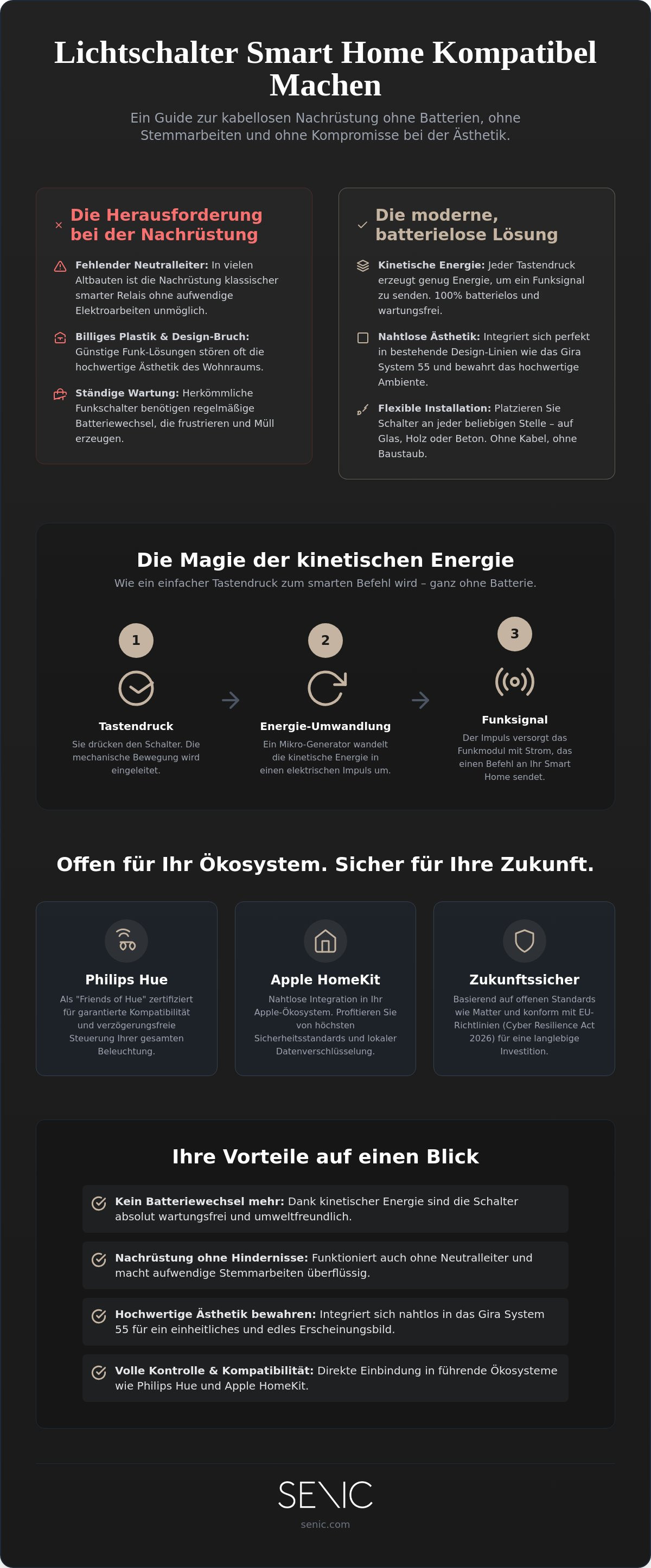
Smart relays are permanently installed in the flush-mounted box. They physically switch the current flow. In Germany, this usually requires a neutral conductor (blue cable). However, many older buildings lack this. Smart wireless switches, on the other hand, send signals directly to a bridge or to the cloud. They do not require permanent wiring to the power grid. For tenants, this is the ideal solution. The switches can be removed without a trace when moving out. Owners appreciate the freedom to place switches anywhere without having to chisel walls.
The importance of ecosystem certification
Certifications guarantee technical stability and longevity. The "Friends of Hue" seal ensures that a light switch is smart home compatible and interacts seamlessly with the Philips Hue system. This prevents delays in switching. Apple HomeKit compatibility also requires the highest security standards for local data encryption. Avoid proprietary systems from budget providers. These often lead to a technical dead end. They can rarely be networked with devices from other manufacturers. Rely on open standards for a future-proof home.
Wired vs. wireless: The technological differences
The decision between wired and wireless systems is more than a technical detail. It determines how profoundly your building structure will be impacted. Anyone who wants to make a light switch smart home compatible usually faces two extremes: complex electrical installations or reliance on batteries. Both approaches come with compromises that modern kinetic solutions skillfully circumvent. The technological basis determines whether you need a specialized company or can complete the modernization yourself in a few minutes.
The neutral conductor problem
Classic smart switches that function as relays require a constant power supply. In Germany, electrical installations are often designed so that only the phase arrives at the switch. The neutral conductor is missing in the switch box. Without this conductor, a conventional smart module cannot work as soon as the circuit is interrupted. Rerouting this line requires chiseling open walls and subsequent plastering. Battery-free wireless light switches elegantly solve this problem. They are physically separated from the power grid. They can simply be glued or screwed to the wall. This saves budget and avoids construction dust in inhabited rooms.
Maintenance-free through Kinetic Energy
The use of kinetic energy is the gold standard for sustainable smart homes. With every button press, a tiny generator converts mechanical movement into an electrical impulse. This impulse is sufficient to send a radio signal. This technology makes batteries completely superfluous. This is a crucial advantage for the environment and your comfort. You never have to think about checking or replacing batteries again. Such a switch is inherently maintenance-free. It offers reliability that extends beyond the lifespan of many digital gadgets. It is a permanent solution that simply works.
Signal stability is ensured by the underlying smart home communication protocols. In modern buildings with a lot of reinforced concrete, this is critical. Protocols like Zigbee use mesh technologies to circumvent range problems. Kinetic switches send their signals directly to the hub, which minimizes latency. The result is immediate lighting response without noticeable delay. Anyone who wants to retrofit a light switch to be smart home compatible should therefore pay attention to signal strength and penetration of obstacles.
The choice of hardware should improve your quality of life, not add new tasks to your to-do list. If you value design and absolute freedom in placement, our solutions for a battery-free home are the ideal choice for a modern living environment.
Checking compatibility: Radio protocols and ecosystems
When retrofitting a light switch to be smart home compatible, you primarily choose a language for your home. Radio protocols form the invisible backbone of every installation. They determine the speed of commands and the stability of the entire network. An unsuitable protocol leads to delays or connection interruptions. The choice should therefore be well-considered and match the existing ecosystem. Only then can a seamless experience be created without technical friction.
WLAN switches seem tempting at first glance. They connect directly to the router. But this convenience comes at a price. Each switch occupies its own IP address. In a household with many smart devices, standard routers quickly reach their load limits. The result is unstable connections and high power consumption of the end devices. The future belongs to the Matter smart home standard. It was developed to break down barriers between manufacturers like Apple, Google, and Amazon. Matter ensures true interoperability and makes your investment future-proof.
Philips Hue Integration
A "Friends of Hue" certified switch offers the deepest integration into the Hue universe. It is directly recognized in the Hue app. Configuration takes less than two minutes. Users can freely assign buttons. A short press activates a light scene, a long press steplessly dims the light. These switches work perfectly with the Hue Bridge. They guarantee delay-free control that feels as natural as a classic light switch. It is the ideal solution for users who do not want to compromise on reliability.
Apple HomeKit for iOS users
For users in the Apple ecosystem, HomeKit is the preferred platform. Control is centralized via the Home app or by Siri voice command. Making a physical light switch smart home compatible opens up complex automation possibilities here. A button press can not only turn off the light but simultaneously lower the heating and lock the front door. HomeKit places great importance on security. Communication primarily takes place locally. Your data remains within your own four walls. This protects privacy and ensures extremely short reaction times for every switching process.
Design and integration: Aesthetics meets function
A coherent room concept is often defined by the smallest details. Clunky plastic housings or technical add-on modules disrupt the visual balance of well-designed interior architecture. Anyone who wants to make a light switch smart home compatible is usually looking for a solution that seamlessly integrates into the existing design. Technology should simplify everyday life without visually taking center stage. High-quality surfaces and precise mechanical feedback when pressed make the difference between a simple gadget and a professional furnishing element.
Gira System 55 Compatibility
The Gira System 55 forms the foundation for modern residential design in Germany. It offers an enormous variety of frames and inserts that are installed in millions of households. Our smart solutions are precisely tailored to this standard. They can be easily integrated into existing multiple frames. For you, this means: the new smart switch sits directly next to the classic socket, without any visual break. Maintaining this uniform look is a decisive criterion for discerning owners. Should you later decide on a different color concept, the rockers can be replaced in a few simple steps during renovations.
Colors and materials play a central role in spatial effect. Classic matte white subtly blends into light walls. Anthracite, on the other hand, sets modern accents in minimalist environments or on dark surfaces. This selection allows the switch to be perfectly matched to furniture and wall colors. There are also specialized options for outdoor use. A smart switch for the terrace allows light control directly from the barbecue area, without cables having to be pulled through the facade. The housing is robustly constructed to easily withstand moisture and extreme temperature fluctuations.
Placement without limits
Wireless installation opens up entirely new possibilities for interior design. Place light switches where they are actually needed, not where the cables are located. Glue control elements onto glass walls in offices or directly onto tiles in the bathroom. If you integrate glass surfaces into your design, the Sunshield Group offers specialized coating solutions for protection and refinement. A switch on the bedside table allows you to turn off the entire house with just one click, without having to get up. This freedom of placement is a significant advantage of battery-free radio technology. You use the available space more efficiently and significantly increase operating comfort.
Choose the right smart home compatible light switch for your project now and rely on German engineering in Gira design.
The Senic solution: Why battery-free should be the standard
Senic redefines expectations for modern control elements. Our Senic Friends of Hue switches are the result of precise German engineering. They combine minimalist aesthetics with functionality that makes no compromises. Anyone retrofitting a light switch to be smart home compatible today seeks security and durability. We consistently rely on kinetic EnOcean technology. This converts mechanical pressure directly into a radio signal. The result is a system that operates completely without an external power supply. It is the cleanest form of networking for your home.
Setup is intuitive via the Philips Hue App. Professionals appreciate the enormous time savings during installation. DIY enthusiasts love the simplicity. One button press is enough to pair the device. Full integration into Apple HomeKit opens up additional levels of automation. Your switch becomes a central tool for complex scenarios. Light, temperature, and security merge into one unit. Everything works without delay and locally. This guarantees maximum privacy within your own four walls.
Sustainability and longevity
True innovation protects resources. Battery-free operation means the end of unnecessary electronic waste. Millions of small batteries end up in special waste annually. With kinetic energy, this problem is a thing of the past. Our switches are designed for years of daily use. The mechanics are robust and maintenance-free. You invest in a solution that lasts. Learn more about the details and technical advantages of the Senic Single Indoor Switch. It's perfection you can feel with every click.
From single room to whole house
Good systems grow with your needs. You can start with a single switch in the living room. Scalability is limitless. Gradually expand your system to all rooms. We offer special solutions for installers and commercial large-scale projects. A smart home compatible light switch from Senic fits wherever quality matters. The advantages of future-proof lighting control are obvious:
- Maintenance-free: Never change batteries or check cables again.
- Design continuity: Perfect fit in Gira System 55 frames.
- Flexibility: Installation anywhere without regard to wiring.
- Future-proof: Compatible with the most important ecosystems worldwide.
The decision for a battery-free system is a commitment to quality and comfort. It is the logical choice for anyone who understands technology as an invisible helper. Make your home ready for the future. Without stress. Without batteries. Simply smart.
Make your home future-proof
Modernizing your lighting doesn't require compromising on design or functionality. You've learned that true flexibility comes from battery-free technology and seamless ecosystem integration. Making a high-quality smart home compatible light switch is now possible without construction dust or specialized personnel. Choosing the right hardware ensures long-term reliability while conserving valuable resources by eliminating the need for batteries.
Opt for a solution that combines aesthetics and efficiency. Our switches are Friends of Hue certified and manufactured with the highest precision in Germany. Thanks to innovative Kinetic Energy technology, your controls remain maintenance-free permanently and integrate perfectly into your existing Gira design. It's the simplest way to integrate modern intelligence into your architecture without changing the character of your rooms.
Discover Senic's battery-free smart home switches and experience how technology works invisibly and perfectly. Start transforming your living spaces into an intelligent oasis of well-being today.
Frequently Asked Questions about Smart Lighting Control
Do I always need a bridge for a smart light switch?
That depends on the chosen radio protocol. Zigbee-based models absolutely require a bridge as a central control unit. WLAN switches connect directly to the router, but can strain network stability if there are many of them. Bluetooth solutions do not require a hub, but offer a severely limited range within solid buildings. For a stable system, a bridge is usually the more professional choice.
Can I install a smart switch if there is no neutral wire present?
Yes, battery-free or battery-powered wireless switches do not require a neutral wire. Since these devices are not physically integrated into the electrical circuit, the need for fixed wiring is completely eliminated. You can simply stick the switch to the wall at the desired location. This is the most efficient solution for old German buildings where the blue neutral wire is often missing in the switch box.
How long do battery-free kinetic switches really last?
Kinetic switches are designed for maximum longevity and usually withstand over 100,000 switching cycles. Since they generate their energy purely mechanically from the button press, there are no batteries that could leak or lose capacity. With average use, this corresponds to a lifespan of several decades. It is a maintenance-free investment that functions reliably throughout the entire lifespan of your home.
Do Friends of Hue switches also work with Apple HomeKit?
Yes, Friends of Hue switches are fully compatible with Apple HomeKit, provided they are integrated via a Hue Bridge (version 2.0). Once the switch is configured in the Hue app, it automatically appears in the Apple Home app. There, the buttons can be assigned to individual HomeKit scenes to control devices from other manufacturers simultaneously.
Can I use smart switches outdoors?
Special outdoor models allow smart control on terraces or in gardens without any problems. These devices have an appropriate IP certification, which guarantees protection against splashing water and weather influences. When purchasing, make sure that the chosen smart home compatible light switch is explicitly approved for outdoor use to avoid material damage due to moisture.
Do I have to completely remove my old light switches?
No, you don't necessarily have to remove your existing installation. Smart wireless switches can often be mounted over existing flush-mounted boxes or placed directly next to them. If you want to maintain the design, you can replace the old switch inserts with radio modules or integrate kinetic switches into the frame programs. This preserves the look of your interior while digitally expanding functionality.
What happens in the event of a power outage or internet outage?
In the event of an internet outage, local systems like Zigbee or HomeKit continue to function without restriction via the bridge. Physical control via the wall switch remains active. In the event of a complete power outage, smart light sources switch off, as they require a constant power supply. As soon as the power returns, the devices resume their defined status, which you can individually configure in the respective app.
How many lamps can I control with a single smart switch?
The number of controllable lamps is primarily limited by the software of your smart home system. A single smart home compatible light switch can switch entire lighting groups or rooms simultaneously. In the Hue app, for example, up to 50 light sources can be assigned to a bridge, all of which can theoretically be activated via a single switch. This allows complex lighting scenarios with just one button press.

0 comments