

When was the last time you frustratingly pressed a wall switch, only for the battery to die at the most inconvenient moment? True technological freedom means your control works without you ever having to think about power again. A modern HomeKit switch without a battery uses the pure power of your touch to transmit signals. This kinetic energy harvesting puts an end to annoying maintenance intervals and unnecessary battery waste in your smart home.
You appreciate an environment that impresses with reliability and minimalist design. Bulky plastic housings and noticeable delays when switching disrupt modern living standards. In this article, you will learn how to make your Apple HomeKit setup permanently maintenance-free while maintaining full aesthetic control. We show you how kinetic switches enable seamless integration into your existing switch design. Look forward to a solution that reacts instantly to every press of a button and finally lets technology work invisibly in the background again.
Key Takeaways
- Understand the principle of energy harvesting, which converts mechanical button presses into electrical energy for lifelong use.
- Learn why a HomeKit switch without a battery is the most sustainable solution for your smart home, eliminating annoying maintenance intervals.
- Learn the technical requirements for stable integration via the Philips Hue Bridge to control scenes without delay.
- Discover the aesthetic advantages of the Gira System 55 standard for a uniform design throughout your living space.
- Benefit from official Friends of Hue certification, which guarantees maximum reliability and easy installation without wiring.
What is a HomeKit Switch Without a Battery?
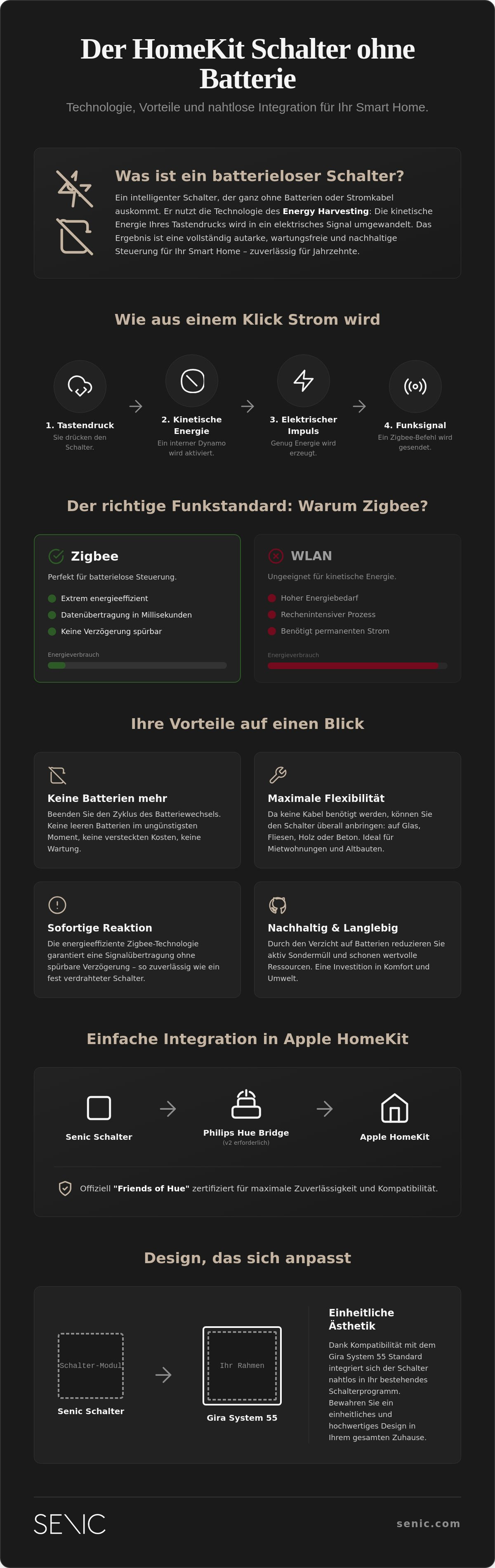
A HomeKit switch without a battery represents the consistent evolution of smart home control. While conventional wireless switches rely on chemical energy storage, this technology uses the principle of kinetic energy. With every button press, mechanical force is immediately converted into electrical energy. This energy is sufficient to send a stable radio signal to your control center. It is a self-sufficient solution that works completely without external power supply or internal batteries.
The technological difference to classic models is fundamental. Traditional smart home switches use batteries that lose voltage over time. This often leads to delayed reactions or sudden failures. A kinetic switch, on the other hand, remains operational for decades. It is maintenance-free and offers reliability that is second to none compared to hard-wired light switches. For Apple HomeKit users, this means: The lights react immediately, and the system remains stable without you ever having to check the charge level.
True sustainability in the smart home begins with the energy source. The elimination of batteries not only reduces special waste but also conserves valuable resources required for the production of button cells. The technology behind battery-free wireless is called energy harvesting. It is an elegant method of generating energy directly at the point of need. This makes your intelligent home not only more comfortable but also more ecologically responsible.
The End of Battery Replacement
In many households, dozens of smart home devices accumulate. Each one requires attention in the form of maintenance intervals. The problem with button cells like the CR2032 is well known: they are often empty exactly when you need them most. A HomeKit switch without a battery ends this cycle. There are no hidden costs for replacement batteries and no effort for disposal. Reliability becomes the standard. It's technology that disappears into the background and simply works. This saves time and protects nerves in everyday life.
Areas of Application in the Modern Home
The flexibility of these switches is a decisive advantage for modern living concepts. Since no cables are needed, there is no dusty chiseling of slots in the walls. This makes the solution ideal for rented apartments or listed buildings. You can place a HomeKit switch without a battery on almost any surface:
- Directly on glass walls in modern bathrooms or offices.
- On kitchen backsplashes made of tiles or stainless steel.
- On the side of furniture or directly on the wooden bedpost.
Whether you use the device as a permanently installed wall switch or as a mobile remote control on the coffee table is up to you. The flat design allows for mounting without a flush-mounted box. You simply stick or screw the switch where you need it. This way, technology adapts to your life, not the other way around.
The Technology Behind Battery-Free Wireless: Kinetic Energy Explained
The magic of a HomeKit switch without a battery lies in applied physics. While conventional smart home devices passively rely on a full energy store, this switch actively generates its power at the moment of use. The core is an EnOcean module that works on the principle of energy harvesting. A brief press of the rocker is enough to convert mechanical energy into an electrical impulse. This impulse is tiny but strong enough to send an encrypted radio telegram to the control center.
The question often arises as to why there are no battery-free switches based on WLAN. The answer lies in the physical reality of energy efficiency. A WLAN handshake is a computationally intensive process that requires comparatively a lot of energy for initialization and data transmission. The force of a single finger press is simply not enough to operate a WLAN module stably. Zigbee, on the other hand, is optimized for extreme efficiency. A Zigbee data packet is transmitted in milliseconds. This is what makes battery-free control possible in the first place and ensures noticeable latency-free operation in everyday life.
How a Click Becomes Electricity
Inside the housing, an electrodynamic energy converter works. You can imagine this component as a highly efficient, tiny dynamo. Kinetic energy explained this process as precise induction: The movement of a magnetic field in a coil creates voltage. This technology is designed for impressive longevity. High-quality modules are tested for over 50,000 switching cycles. This means a lifespan of several decades with normal use. There are no chemical components that age, and no contacts that could corrode due to leaking batteries. The energy is always available exactly when you operate the switch.
Zigbee vs. Bluetooth vs. Thread
Why is Zigbee the standard for solutions like the Friends of Hue switch? The answer is mesh technology. Every permanently installed Philips Hue lamp acts as a repeater and forwards the signal. This massively increases the range throughout the house. While Bluetooth often fails with solid walls, Zigbee reaches up to 20 meters indoors. Outdoors, distances of up to 300 meters are even possible.
With the current Matter standard in version 1.5, interoperability between different systems becomes even easier. Nevertheless, the proven Zigbee protocol via the Philips Hue Bridge remains the most stable basis for battery-free hardware. It offers the perfect balance of range, security, and minimal energy requirements. If you want to future-proof your system, choosing a certified solution is crucial. Experience this maintenance-free freedom with the Single Indoor Switch, which perfectly combines technology and aesthetics.
Apple HomeKit Integration: How It Works
Seamless integration into the Apple ecosystem is the goal of many smart home enthusiasts. A HomeKit switch without a battery offers a particularly elegant solution here, as it combines physical haptics with digital intelligence. The setup is not done directly via Bluetooth or WLAN but uses a proven workaround that ensures maximum stability. It is the combination of hardware precision and software logic that defines the user experience.
Once the switch is integrated into your system, it functions as a universal control device. You are no longer dependent on your smartphone or voice commands. A short press of a button at the entrance is enough to start complex processes. This local control is a key advantage. Since the signals are processed directly, your home remains operable even in the event of internet outages. It's the perfect symbiosis for a home that simply works.
The Role of the Philips Hue Bridge
Battery-free switches require a dedicated translator to communicate with Apple HomeKit. The Philips Hue Bridge (v2) takes on this task. The switch sends its kinetic Zigbee signal to the Bridge, which immediately forwards the command to the HomeKit framework. This process takes only milliseconds. A detailed Apple HomeKit integration ensures that the switch appears in the Apple Home App immediately after pairing once in the Hue App. There it is listed as a configurable input device, which centralizes and simplifies management.
Create HomeKit Automations
The true strength lies in the flexibility of button assignment. A typical HomeKit switch without a battery usually offers four button points that you can freely program in the Home App. You are not limited to light sources. You can use it to control the entire spectrum of your compatible devices:
- Activation of scenes like "Movie Night" (dim lights, close blinds).
- Control of music playback on HomePod or AirPlay speakers.
- Regulation of thermostats or switching smart sockets.
A practical example is the "Good Night" scene directly next to the bed. One click turns off all lights in the house, locks the front door, and lowers the temperature in the bedroom. You don't have to pick up a device or give voice commands. The haptics of the mechanical click give you immediate confirmation that the command has been executed. This is convenient technology that adapts to people.
Design and Installation: Aesthetics Meets Function
An intelligent home should not look like a technical experiment. True innovation integrates invisibly into existing architecture. A HomeKit switch without a battery solves the aesthetic dilemma of many smart home users. It dispenses with cheap plastic optics and instead relies on high-quality materials and proven industrial standards. The result is a control that is haptically and visually indistinguishable from classic light switches. It is technology that you enjoy touching.
Haptic feedback is a crucial factor for acceptance in everyday life. While touch surfaces often appear sterile, the mechanical pressure point of a kinetic switch offers clear confirmation. This "click" immediately signals to the user that the command has been sent. There is no uncertainty as to whether the lamp will react or not. This reliability makes the switch an ideal tool for any room, from the bedroom to the hallway.
Seamless Integration into Existing Frames
The biggest advantage for aesthetes is compatibility with the Gira System 55. This dimension of 55x55 mm is a widespread industrial standard. It is used by leading manufacturers such as Gira, Jung, Merten, and Berker. For you, this means: you can integrate the smart home switch into your existing multiple frames. The HomeKit switch without a battery then sits perfectly flush next to your conventional sockets. This way, you avoid unsightly "smart home sprawl" on the walls. The look remains uniform and high-quality. Available in four different color variants, the design adapts to any interior style, from modern anthracite to classic alpine white.
Mounting on Any Surface
Installation is radically simple and often takes less than two minutes. Since no electrical wiring is required, tedious drilling is eliminated. You have complete freedom in placement. With the included adhesive strips, the switch can be attached to almost any surface:
- On glass walls in modern bathrooms where no cables can be laid.
- On kitchen islands or tiled backsplashes for quick access while cooking.
- Directly next to the bed on wooden surfaces or wallpaper.
For outdoor use, the Single Outdoor Switch offers a robust solution. It withstands rain and extreme temperatures, while achieving a wireless range of up to 300 meters outdoors. Whether in the garden or in the living room: assembly remains clean and flexible. If you move, simply take the switches with you. No holes or damaged wires are left behind. This makes the system particularly attractive for tenants and renovators who value quality.
Discover the freedom of wireless mounting with the Single Indoor Switch and design your home according to your ideas.
Why Senic Is the First Choice for Battery-Free HomeKit Switches
The decision for a smart home component is always also a decision for long-term stability. Senic positions itself here not as a mere hardware supplier, but as an official "Friends of Hue" partner. This certification guarantees that every HomeKit switch without a battery communicates seamlessly with the Philips Hue Bridge. It is this deep integration that minimizes system failures and ensures a constant response time. While other solutions often become unstable due to firmware conflicts, Senic offers certified security that has been specifically optimized for the Apple ecosystem. Regular software updates ensure that the devices remain compatible with future HomeKit generations and the Matter standard.
Sustainability at Senic is not a marketing slogan, but an integral part of the company philosophy. The elimination of batteries saves hundreds of button cells over the lifespan of a house. This reduces the ecological footprint and eliminates special waste. It is the consistent implementation of a maintenance-free concept that focuses on longevity and resource conservation. Anyone who chooses this technology invests in a future where comfort and ecological responsibility go hand in hand. The system is designed to remain a part of your architecture for decades without ever requiring attention in the form of maintenance.
Premium Quality for Demanding Users
The haptic quality of Senic products results from precise German engineering. Only high-quality plastics are used, which are characterized by a pleasant surface structure and high UV resistance. Whether in elegant matte black or classic alpine white: the switches blend harmoniously into demanding living environments. The internal mechanics are designed for maximum load-bearing capacity and tested for tens of thousands of switching operations. You feel this quality with every click. It is the ideal of "invisible" technology that perfectly fulfills its task without negatively attracting attention through maintenance requirements or cheap optics. Thanks to compatibility with the Gira System 55, your interior design also remains visually consistent.
Conclusion: The Path to the Perfect Smart Home
A modern smart home should simplify everyday life, not complicate it. Battery-free technology marks the end of small frustrations in the household. You gain autonomy and save time and money on replacement batteries in the long run. The combination of aesthetic design, easy installation, and absolute reliability makes the system the superior choice for Apple users. The investment in kinetic energy quickly pays off through complete maintenance-free operation and the high quality of the components.
If you're ready for the next level of home automation, you'll find the right bundles for your project in the Senic Shop. Whether you're starting with a single indoor switch or want to equip an entire floor, it's the easiest way to make your home smarter, more beautiful, and more sustainable. Rely on a solution that works today and will continue to define the standard for modern living in 2026.
Ready for the Maintenance-Free Future of Your Home
Choosing a HomeKit battery-free switch marks the definitive farewell to unnecessary maintenance and chemical battery waste. By using kinetic energy, you gain an independence that conventional smart home solutions often lack. Your system remains permanently reliable and haptically convincing. Thanks to seamless compatibility with the Gira System 55, the hardware integrates flush into your existing architecture. As an official Friends of Hue partner, Senic also offers technical stability that will last for years and meet future standards. It is the symbiosis of ecological sustainability and technical precision that truly makes your smart home intelligent.
Transform your living spaces now into an environment that adapts to your needs, without ever demanding attention in the form of battery changes again. Discover Senic's battery-free switches and rely on a solution that uncompromisingly combines design and functionality. Your maintenance-free home awaits you.
Frequently Asked Questions
How exactly does a battery-free switch work?
A HomeKit battery-free switch works with an electromechanical transducer inside. This instantly converts the force of your finger press into electrical energy. This energy is sufficient to send an encrypted Zigbee radio signal to your control center. It is a completely self-sufficient system that requires no external power source and therefore remains maintenance-free for life.
Do I need a bridge for HomeKit for the Senic switch?
Yes, a second-generation Philips Hue Bridge is absolutely necessary for integration into Apple HomeKit. The switch communicates wirelessly with the Bridge, which then transmits the signal to your Apple ecosystem. This ensures an extremely stable connection and enables convenient control via Siri or the Apple Home App.
Can I also control HomeKit scenes with a battery-free switch?
Absolutely, you can individually link each button of the switch to complex scenes in the Apple Home App. A single press can simultaneously dim the lights, close the blinds, and start your music playback. You are not limited to light sources but can control any HomeKit-compatible device in your home.
Is the click of a kinetic switch louder than with normal switches?
Due to its design, the switching sound is slightly louder and more mechanical than with a classic light switch. This characteristic click is the acoustic feedback of energy generation at the moment of pressing. Most users perceive this clear, precise sound as a valuable confirmation of a successfully triggered switching operation.
Do battery-free switches also work outdoors?
Yes, for use in the garden or on the terrace, there is the special Single Outdoor Switch. This is designed according to IP44 weather-resistant and withstands rain and extreme temperatures. Outdoors, the kinetic radio technology achieves an impressive range of up to 300 meters, provided there is a clear line of sight to the Bridge.
What happens if I press the switch very quickly in succession?
The switch processes rapid inputs absolutely reliably. Since the energy is physically regenerated with each individual press, there are no waiting times or delays due to charging cycles. Every command is sent immediately and processed by the Hue Bridge, which guarantees smooth operation in everyday life.
Can I install the switch in my existing Gira frames?
Integration into the Gira System 55 is easily possible. The switch insert uses the standard size of 55x55 mm. You can simply insert it into your existing single or multiple frames. This way, you maintain a uniform design on your walls while modernizing your home technology.
What is the lifespan of a kinetic switch?
The mechanics are designed for maximum durability. A high-quality HomeKit battery-free switch is tested for over 50,000 switching cycles. With average use, this corresponds to a service life of significantly more than 20 years. Since no batteries can leak or contacts corrode, the electronics remain permanently protected.

0 comments