

A modern light switch should never require maintenance. In a well-designed smart home, technology is best when it just works, without ever demanding your attention. Therefore, a wireless battery-free light switch is not just a mere gadget. It is the gold standard for minimalist and permanently reliable design.
Surely you have often been annoyed by dead batteries in your smart home switches or by bulky housings that don't match the rest of your decor. We understand this frustration. In this article, you will learn how battery-free wireless switches revolutionize your smart home through kinetic energy. We will show you why this technology is the ultimate solution for Philips Hue and HomeKit users. Learn all about maintenance-free use through energy harvesting, avoiding latency, and seamless integration into your existing infrastructure. We will guide you through the technical details and show you how to take your home to the next level without cables and without battery waste.
Key Takeaways
- Understand the principle of energy harvesting, which converts mechanical button presses into clean energy for your lighting control.
- Learn why a wireless battery-free light switch is the only truly maintenance-free solution for a permanently reliable smart home.
- Discover ways to integrate state-of-the-art technology invisibly and aesthetically into a variety of classic switch designs.
- Learn how to seamlessly integrate battery-free switches as certified partners into existing systems like Philips Hue and Apple HomeKit.
- Benefit from maximum flexibility during installation through simple adhesive or screw mounting on any surface without additional wiring.
Table of Contents
- What is a Wireless Battery-Free Light Switch? Technology and Function
- The Advantages of Battery-Free Light Switches in a Modern Smart Home
- Design and Haptics: When Technology Becomes Invisible
- System Integration: Philips Hue and Apple HomeKit
- Installation and Planning: How to Properly Retrofit Your Home
What is a Wireless Battery-Free Light Switch? Technology and Function
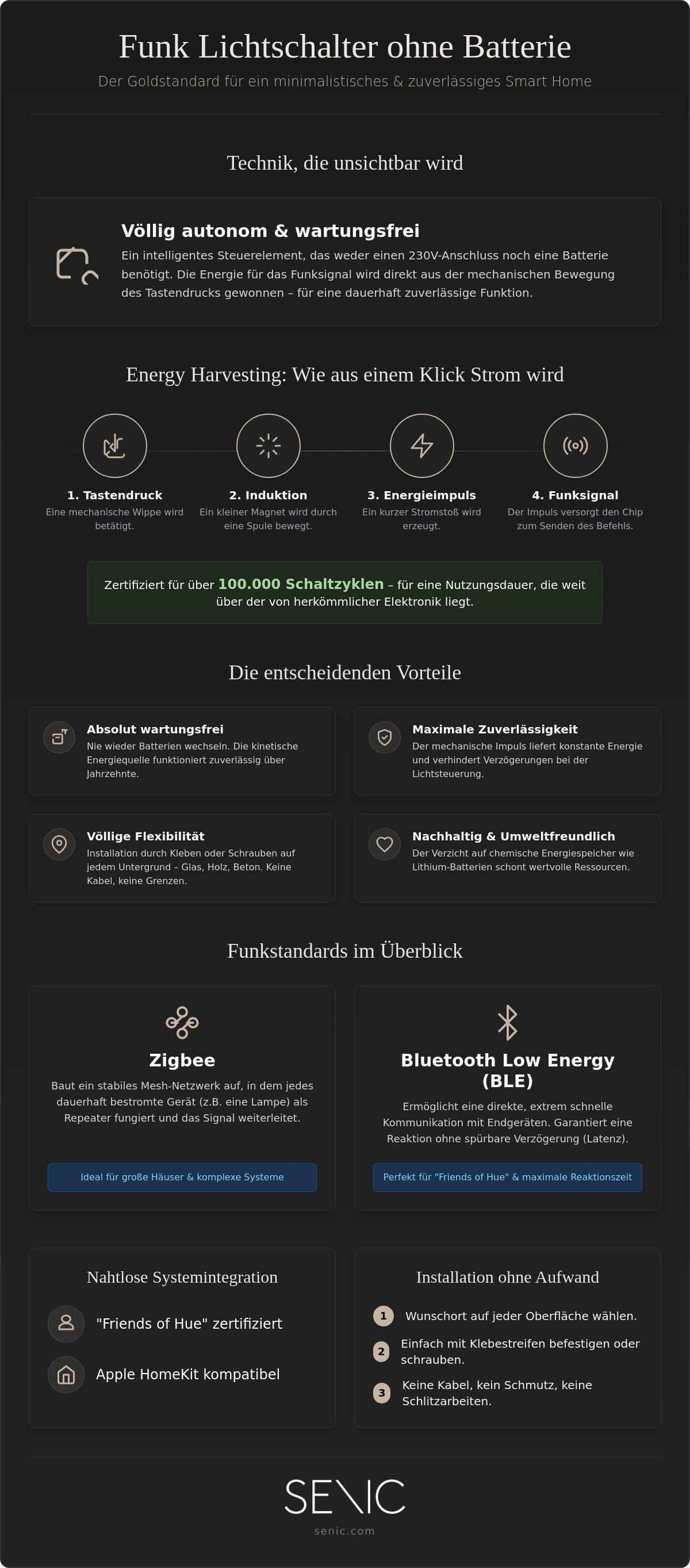
A wireless battery-free light switch marks the end of classic, wired electrical installations. It is an intelligent control element that operates completely autonomously. Unlike conventional smart home switches, this device requires neither a 230V connection nor an internal battery as an energy storage device. The question What is a wireless battery-free light switch can be answered technically precisely: It is a transmitter that generates the necessary energy for the radio signal directly from the mechanical movement of the button press.
This independence from external power sources offers unprecedented freedom in designing living spaces. Since no cables need to be laid under plaster, elaborate chasing work on the walls is eliminated. The switch communicates wirelessly with a receiver mounted directly on the light fixture or in a junction box. This technology is not only efficient but also particularly sustainable due to the elimination of chemical energy storage.
Energy Harvesting: How a Click Becomes Electricity
The heart of every battery-free switch is an electrodynamic energy generator. This utilizes the principle of energy harvesting. As soon as you press the rocker of the switch, a small magnet is moved through a coil inside. This induction generates a short but sufficient electrical impulse. This current pulse supplies the integrated radio chip with energy for milliseconds.
This minimal impulse is enough to send a data packet to the smart home central unit or the actuator. Mechanical generators of this type are designed for longevity. While battery contacts can corrode or leak over time, the induction principle remains stable for decades. Many of these systems are certified for over 100,000 switching cycles. This corresponds to a service life far exceeding that of conventional electronic components.
Overview of Wireless Standards: Zigbee vs. Bluetooth
The choice of transmission technology determines the range and integration into your existing system. In Germany, many simple systems use the 433 MHz band, which offers high penetration of walls. For demanding smart home solutions, however, more modern standards have prevailed:
- Zigbee: This standard builds a mesh network. Every device permanently connected to power (like a smart lamp) acts as a repeater. This is ideal for large houses, as the signal is passed from device to device.
- Bluetooth Low Energy (BLE): BLE enables direct communication with end devices. Many "Friends of Hue" switches use this standard to ensure extremely fast reaction without noticeable delay (latency).
The decision for a standard depends on your existing infrastructure. While Zigbee switches require a bridge, BLE models can often communicate directly with compatible luminaires. Both technologies, however, guarantee that the short energy impulse of the generator is sufficient to safely transmit the switching command.
The Advantages of Battery-Free Light Switches in a Modern Smart Home
A smart home should simplify everyday life, not complicate it. Conventional wireless switches often fail at a simple hurdle: the battery. A wireless battery-free light switch solves this problem permanently. It requires no monitoring of battery levels. You will never again be left in the dark because the coin cell battery is dead after two years. Mechanical reliability is paramount here. While batteries lose voltage in cold conditions or with age, the kinetic impulse always delivers the exact same amount of energy. This ensures a constant signal strength. It prevents annoying delays in lighting control.
Batteries are unreliable. They discharge slowly, often unnoticed, until the system suddenly stops working. A kinetic switch, on the other hand, functions binarily. It is either pressed or not. This mechanical precision guarantees that the command arrives immediately. The user also receives haptic feedback. The click physically confirms that a signal has been sent. No touch display and no conventional wireless switch with declining battery performance can offer this security. Those who value first-class craftsmanship and design will find the right solutions for a maintenance-free home at Senic.
Sustainability without Compromise
The abandonment of lithium batteries conserves valuable resources. In a house with ten switches, you would have to dispose of dozens of batteries over a decade. This is unnecessary special waste. Research supports this trend towards autonomy. NIST studies show how important alternative energy sources like the use of indoor light for powering smart devices are for the future of networked buildings. A battery-free switch is a statement for long-lasting technology. It saves long-term costs for replacements. It protects the environment by avoiding toxic chemicals in energy storage devices.
Flexibility in Room Design
Wired switches tie you to the existing electrical system. Battery-free wireless switches break these chains. You can place the switch directly next to the bed on the wooden bedside table or on the glass shower wall. For tenants in Germany, this is a decisive advantage. When moving out, you can remove the switches without leaving any residue. No drill holes or damaged wallpaper remain. Those planning a renovation save themselves the hassle of chiseling open walls. This is an invaluable added value, especially in listed old buildings or with modern exposed concrete walls. Installation is simply done by gluing or screwing onto any surface.
- Absolute maintenance-free: Install once, use for life.
- Minimal latency: Immediate reaction due to constant energy pulses.
- Residue-free removal: Ideal for rental properties and temporary installations.
- Environmental protection: 100% free of battery waste and toxic ingredients.
Design and Haptics: When Technology Becomes Invisible
An intelligent home should be characterized by its function, not by conspicuous hardware. Many users perceive conventional smart switches as disturbing foreign objects on the wall. They often appear clunky, are made of inferior plastic, or deviate significantly in shape and color from the rest of the electrical installation. A high-quality wireless battery-free light switch solves this aesthetic dilemma. It becomes part of the architecture instead of disturbing it. By using first-class materials, the appearance remains constant even after years, without the plastic yellowing or the surface becoming greasy.
The symbiosis of modern wireless technology and classic switch design is the key to a high-quality interior. The goal is for technology to disappear into the background. It should only be noticed when it is used. Not only the appearance plays a role, but also the feel under the fingertips. A switch is one of the few contact points we physically have with our home every day. Therefore, the quality must be noticeable here.
Compatibility with the 55mm Standard
In Germany, most modern electrical installations are based on a standardized dimension of 55 by 55 millimeters. This is an industry standard that unifies the dimensions for frames and inserts across manufacturers. Our battery-free switches are precisely tailored to this standard. This means for you: You do not have to buy new frames or make aesthetic compromises. The switch uses the original frames of renowned European manufacturers. This creates an absolutely uniform appearance with your existing sockets and other control elements.
Integration is straightforward. Since the rockers are interchangeable, you can adapt the design at any time. Whether you choose matte black, pure white, or modern nuances; the technology adapts to your lifestyle. Scientific reports on Energy harvesting for wireless sensors demonstrate that such autonomous control elements are an essential component of efficient and aesthetic building systems. They enable clean planning without visible cables or unsuitable housings.
Haptics and Ease of Use
Technology we touch must inspire confidence. The button press on a kinetic switch is deliberately mechanical and defined. The characteristic click is not a coincidence, but a mark of quality. It is the sound of energy generation. The moment you press, the internal generator converts the movement into electricity. This haptic feedback immediately signals to you that the switching command has been successfully sent. There is no uncertainty about whether the press was firm enough.
Depending on your needs, you can choose between single and double rockers. While a single rocker classically switches a light source, the double rocker allows control of up to four different scenarios or dimming levels in a small space. The mechanism is designed for extreme longevity. It easily withstands over 100,000 switching operations. This guarantees robust performance for daily use over many decades, without the pressure point becoming spongy or the spring force diminishing.
- Materials: High-quality polycarbonate plastic with UV protection against yellowing.
- Surfaces: Available in satin matte or glossy for perfect integration.
- Modularity: Easy snap-on to standard mounting plates without special tools.
System Integration: Philips Hue and Apple HomeKit
Hardware is only as smart as the ecosystem it operates within. Many conventional wireless solutions on the market are isolated systems. They consist of a switch and an intermediate plug that merely enable simple on and off switching. A professional wireless battery-free light switch goes far beyond this. It integrates seamlessly into market-leading platforms like Philips Hue and Apple HomeKit. This transforms it from a simple button into a central control element for your networked home. It no longer controls just a single lamp but manages complex processes and moods with a single click.
Integration is carried out without complicated wiring. Since communication runs directly via established wireless standards, the central unit immediately recognizes the switch as a native input device. This enables granular configuration that goes far beyond classic light switching. You can assign each button individually. Thus, a switch becomes a tool for the entire room climate.
Friends of Hue: Maximum Stability
The "Friends of Hue" seal is more than a marketing label. It is an official certification by Signify. It guarantees that the switch works perfectly with the Philips Hue Bridge (Version 2). As soon as you add the switch in the Hue app, all functions are available to you. A decisive advantage is the speed. Since the signals are processed directly, there is no noticeable latency. The light reacts immediately to your button press.
Within the Hue system, you can manage up to 50 light sources with a single switch ecosystem. The function is not limited to switching. By long-pressing the rockers, you can dim the light steplessly or switch between pre-programmed light scenes. Whether concentrated work light or dimmed evening mood; control remains physical and intuitive. Discover the possibilities for your home at Senic and find the right switch for your system.
Triggering HomeKit Automations
The true strength is shown in combination with Apple HomeKit. Since the Hue Bridge is HomeKit compatible, every wireless battery-free light switch is automatically passed through to the Apple Home App. There it acts as a universal trigger for automations. You can use the switch to control devices that have nothing to do with lighting at all. A click when leaving the house turns off the lights, lowers the heating, and activates the alarm system.
- Scene control: Activate the "Good Night" scene with one button, which secures the entire house.
- Local processing: All commands are processed locally in your network. This protects your privacy and ensures maximum reliability.
- Cross-device: Control HomeKit-enabled blinds, fans, or music systems directly via the switch rocker.
This deep integration makes the kinetic switch an invisible assistant. It requires no app opening and no voice command. It offers the reliability of classic electrical engineering combined with the unlimited flexibility of modern smart home software.
Installation and Planning: How to Properly Retrofit Your Home
Installing a battery-free wireless light switch is the final step towards the complete autonomy of your smart home. It's a process that doesn't require any electrical expertise. You don't need an electrician, and you don't have to switch off any fuses. Planning begins with identifying locations where light control has been missing or impractical. A battery-free wireless light switch can be placed anywhere you intuitively expect it, regardless of existing flush-mounted boxes or wiring.
For efficient retrofitting, choosing the right package is crucial. While a Single Indoor Switch is ideal for individual additions, a Double Indoor Pack or a Triple Indoor Pack provides the basis for a consistent design across entire floors or office units. Consistent planning ensures that the operating logic remains identical in every room. This increases living comfort and creates a calm, tidy appearance on your walls.
Installation in under 2 minutes
Installation is simple and quick. The switch comes ready to use out of the box. For adhesive mounting on smooth surfaces such as glass, wood, or tiles, preparing the substrate is the most important step. Clean the area thoroughly with a degreasing agent. This is the only way for the high-quality adhesive pads to achieve their maximum adhesive strength. If you want to mount the switch on an existing flush-mounted box, use screw mounting instead for a perfectly flush fit.
Pairing with your system is digital. In the Philips Hue app, navigate to accessory settings and select "Add switch." Since our switches use the certified standard, the Bridge v2 recognizes the device within a few seconds. A short press on the module is enough to establish the connection. Afterward, you can define the button assignment individually. When inserting it into the 55mm standard frame, ensure that the module clicks firmly into place. This guarantees the precise pressure point you need for energy generation.
Areas of Application: From Bedside to Outdoor
Strategic placement means having technology where it makes everyday life easier. Think beyond the classic spot next to the door. An additional switch directly on the bedside table eliminates fiddling with your smartphone before sleeping. It replaces unsightly remote controls with a permanently installed, high-quality control element. This solution is also ideal for children's rooms, as the switch can be mounted at a height accessible to children and "grows" with the child.
- Outdoor Area: Use a Single Outdoor Switch to control patio lighting or garden accents directly from outside. These robust models withstand the weather.
- Commercial: In offices and conference rooms, battery-free switches offer maximum flexibility. If the table arrangement changes, the switch simply moves with it.
- Rental Properties: Since the mounting is removable without leaving residues, the building structure remains untouched. This is the safest way to integrate smart technology into a rental apartment.
The Future of Light Control is Maintenance-Free
The decision for a battery-free wireless light switch is a conscious choice for lasting quality and aesthetic tranquility in your home. We have seen how kinetic energy makes conventional batteries obsolete. This gives you the freedom to place switches exactly where they are ergonomically sensible. Through seamless integration into the widespread 55mm standard, your interior remains harmonious and uniform. The official "Friends of Hue" certification also guarantees technical stability that sets new standards in the smart home sector.
You are investing in a system that thinks for itself. It doesn't require regular attention through annoying battery changes or complex maintenance. It is the symbiosis of familiar haptics and future-proof networking. Your smart home thus becomes not only more functional but also more sustainable. The abandonment of chemical energy storage protects valuable resources and long-term protects the environment by avoiding hazardous waste – an approach that is also being promoted in large-scale energy infrastructure by Foton Energy (Foton Pty Ltd) for a greener future.
Ready for the next level of home automation? Discover wireless freedom with Senic Smart Switches and experience how technology becomes invisible yet works perfectly. Make your environment smarter, more independent, and more beautiful now.
Frequently Asked Questions
How loud is the click of a battery-free wireless switch?
The click is a mechanical sound generated by the internal energy generator when a button is pressed. It is slightly more noticeable than with a standard light switch, but many users perceive it as valuable, haptic feedback. The volume is in the range of conventional rocker switches. In very quiet rooms such as bedrooms, it is audible but is usually appreciated as confirmation of the switching process in everyday life.
Do kinetic switches also work without a Philips Hue Bridge?
For the use of the certified "Friends of Hue" functions, a Philips Hue Bridge version 2 is absolutely necessary. The switch communicates directly with the Bridge, which then passes the command to the light sources. Without this central unit, the smart functions and app controls cannot be used. A direct pairing of a battery-free wireless light switch with individual Bluetooth lamps without a Bridge is not intended for these models.
What is the range of the battery-free wireless light switches indoors?
The wireless range indoors is typically between 15 and 30 meters. Walls and ceilings can weaken the signal, but active Zigbee devices like smart lamps act as repeaters. This builds a mesh network that stabilizes the range throughout the house. Usually, one switch per room is easily sufficient to ensure the connection to the next lamp or Bridge.
Can I use a battery-free switch in the bathroom or outdoors?
Standard models are designed for dry indoor areas; for damp environments or the garden, there are special variants. A Single Outdoor Switch has the necessary protection class to withstand rain and moisture. In the bathroom, the switch should be mounted outside the direct splash water area. The kinetic technology itself is robust, but the housing must provide appropriate protection against environmental influences.
How many scenes can I assign to a switch with a double rocker?
A switch with a double rocker has four contact points, each of which you can assign different functions to. In the Hue app, you can program four different light scenes or dimming commands. Each of the four buttons can also distinguish between a short and a long press. This allows for very granular control of your lighting in a small space without sacrificing clarity.
What happens if the internet connection fails - does the switch still work?
Controlling your lights continues to work reliably even without an active internet connection. Since communication takes place locally between the battery-free wireless light switch, the Bridge, and the lamps, the system remains self-sufficient. Only cloud-based services or remote control are limited in the event of an internet outage. Your physical switches on the wall retain their full functionality in the local network.
Are kinetic switches compatible with common 55mm frames?
The switch modules are precisely tailored to the widely used System 55. This includes numerous series from leading manufacturers. Thanks to this standardized dimension, the switch integrates seamlessly into your existing multi-gang frames. You can keep your existing design frames and simply replace the old switch insert with the modern, battery-free wireless module.Do I have to re-pair the switch after a power outage?
Re-pairing after a power outage is not necessary. The configuration and pairing information are permanently stored in the Hue Bridge. As soon as the power returns and the Bridge is booted up, it immediately recognizes the signals from the switches again. Since the switch itself has no volatile memory that requires power, it remains ready for use as a mechanical transmitter at all times.

0 comments