

A smart home should enhance your aesthetic, not ruin it with cheap plastic remotes or annoying construction mess. Many homeowners shy away from modernization because they fear the noise and dust of traditional electrical installations. But in 2026, breaking open walls for modern control is long outdated. If you upgrade your light switches without having to chisel open walls, you gain maximum flexibility without sacrificing the architectural character of your rooms.
Surely you know the frustration with smart home devices that promise convenience but annoy with constant battery changes or look like foreign objects. You deserve a solution that integrates harmoniously into your daily life and remains permanently reliable. In this article, you will learn how to integrate modern light switches into your system without chiseling walls or maintenance effort. We will show you the way to maintenance-free light control through kinetic energy, which harmonizes seamlessly with Philips Hue and Apple HomeKit. Maintain the design consistency of your Gira System 55 and opt for a professional, durable solution for your connected home.
Key Takeaways
- Learn how to upgrade your light switches without having to chisel open walls by relying on innovative adhesive mounting and wireless transmission.
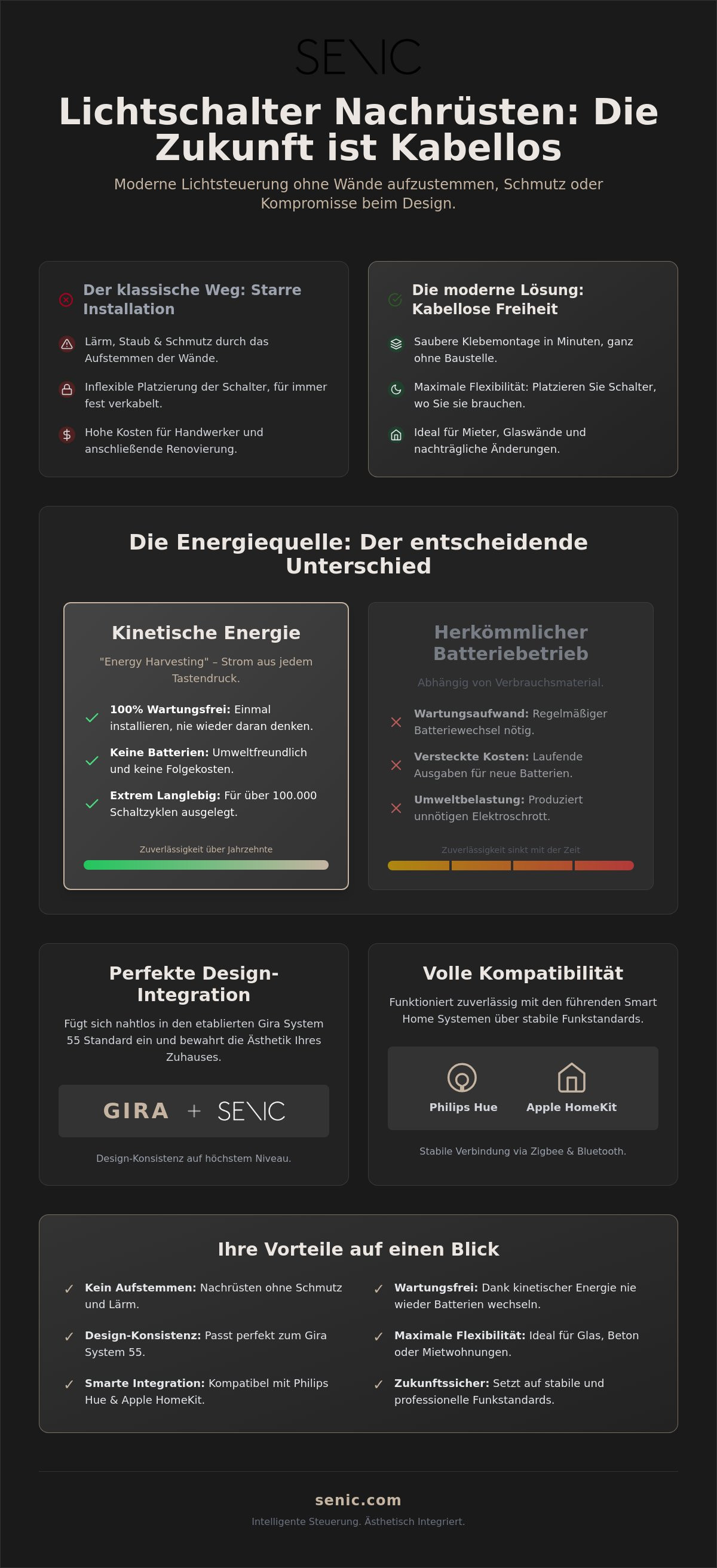
- Discover the benefits of kinetic energy, which makes your smart home control completely maintenance-free and battery-independent through energy harvesting.
- Ensure maximum design consistency through the seamless integration of smart switches into the established Gira System 55 standard.
- Learn how to efficiently integrate and configure wireless wall switches into existing ecosystems such as Philips Hue or Apple HomeKit.
What is a smart wireless wall switch and how does it work?
A smart wall switch is the modern answer to rigid electrical installations. It controls light sources digitally, without being dependent on physical flush-mounted wiring. Instead, it uses radio waves to send commands to smart lights or actuators. Anyone who wants to retrofit a light switch without chiseling open walls relies on this wireless freedom. The functionality of wireless wall switches is based on a transmitter in the housing and a receiver in the lamp or bridge. The result is a clean installation without dust, noise, or expensive electrician hours.
Modern smart homes in 2026 are moving away from centralized, rigid systems towards decentralized intelligence. Wireless switches make it possible to place controls exactly where they are intuitively needed. This not only saves meters of copper cables but also offers a flexibility that would never be achievable with classic wiring. A switch that is glued next to the door today can easily be moved to the back of the sofa tomorrow.
An Overview of Wireless Standards
The choice of protocol determines the reliability of your system. Zigbee, often certified as "Friends of Hue", is the gold standard for stable mesh networks. Each device amplifies the signal, which massively increases the range. Bluetooth Low Energy (BLE), on the other hand, allows direct control without an additional bridge, ideal for smaller setups. Cheap RF solutions (433 MHz) are not recommended. These are often unencrypted and susceptible to interference from other household appliances. A professional smart home requires encrypted, bidirectional communication.
Use Cases Without Cables
Wireless switches solve architectural problems that previously seemed unsolvable. You cannot chisel open walls on glass or mirrored surfaces. Here, adhesive mounting is the only elegant solution. Wireless switches at the head of the bed or on kitchen backsplashes also create comfort without damaging the building structure. For tenants, this technology is a game-changer. They can add an additional light switch without having to chisel open walls and take the entire system with them without a trace when they move out. Two-way switches, which previously required walls to be cut open, can now be configured in seconds via an app.
The technological superiority is particularly evident in durability. While earlier generations often looked clunky, modern solutions integrate seamlessly into existing design lines such as the Gira System 55. It is no longer just about functionality, but about the invisible integration of technology into a sophisticated living environment.
Kinetic Energy vs. Battery: Why Batteryless is the Future
Anyone who wants to retrofit a light switch without chiseling open walls usually seeks maximum convenience. Battery-powered solutions seem attractive at first glance, but often turn out to be a maintenance trap. Technological developments in 2026 clearly show: the future belongs to kinetic energy. The principle of energy harvesting uses the mechanical force of your button press to generate enough electricity for a radio signal. Current research on energy harvesting confirms the efficiency of these systems in modern smart homes. A kinetic switch does not require an external power source. It is self-sufficient.
A smooth-running smart home is characterized by invisible technology. Battery changes disrupt this flow and lead to unnecessary electronic waste. Kinetic switches, on the other hand, are completely maintenance-free. They work immediately with the first click, even after years of disuse. There are no dead batteries at the wrong moment or weakening radio signals. This reliability makes them the superior choice over conventional wireless remote controls.
How does the technology inside work?
A tiny electrodynamic generator converts the movement of the rocker into energy. When pressed, a minimal current pulse is generated, which is sufficient to send a Zigbee or Bluetooth signal. The haptic feedback is precise and high-quality. A short, crisp click physically confirms the action. These mechanical modules are designed for hundreds of thousands of switching cycles. This corresponds to a lifespan of several decades with normal use.
Cost-benefit analysis over 10 years
Let's look at the long-term balance. A battery-powered switch incurs continuous costs for replacement batteries over ten years. Added to this is the time spent troubleshooting when a device suddenly stops responding. The environmental balance of kinetic switches is unbeatable. Since no toxic battery waste is generated, the ecological footprint is massively reduced. While the initial cost of a high-quality kinetic switch may be higher, the investment quickly pays for itself through the elimination of follow-up costs and absolute maintenance-free operation.
If you prioritize durability when you retrofit a light switch without chiseling open walls, the kinetic solution is the only option. For a permanently worry-free experience in your home, the Single Indoor Switch offers the perfect technical implementation. It combines this self-sufficient energy source with a design that requires no compromises.
Design Integration: Gira System 55 and German Aesthetics
Technological excellence demands aesthetic integrity. In many smart homes, the overall impression is ruined by clunky remote controls or cheap-looking plastic buttons that look like foreign objects on the wall. Anyone who wants to retrofit a light switch without chiseling open walls is looking for a solution that blends invisibly into the architecture. In Germany, an established standard for modular switch systems has become widespread for this purpose. This defines a square inner dimension of 55 by 55 millimeters, which enables cross-manufacturer compatibility of frames and inserts. This modular design is the foundation for a consistent design throughout the living space.
Modern surfaces such as matte black, anthracite, or classic silk-gloss pure white allow for precise matching with the interior. A high-quality wireless switch should not differ haptically or visually from permanently wired components. High-quality materials prevent the typical "gadget look" and instead ensure timeless elegance. Especially in open living areas, where light switches are often placed next to sockets in multi-frames, this visual uniformity is indispensable.
Visual Uniformity in the Living Space
Integration into the existing switch program is the decisive factor for a professional result. Instead of installing new, ill-fitting frames, smart wireless modules use compatibility with existing frame series based on this modular standard. The material quality determines the premium impression here. A kinetic switch with a precise pressure point mechanism conveys quality with every touch. The result is a harmonious overall picture in which the intelligent technology remains discreetly in the background.
Mounting Options Without Drilling
The physical installation is completely non-destructive. Thanks to special, industrial adhesive pads, the switches can be fixed to almost any surface.
- Glass and Tiles: Ideal for modern kitchen backsplashes or glass partitions in the bathroom.
- Wallpaper and Plaster: Residue-free removal, which is particularly important in rental properties.
- Existing Boxes: The base plate can be screwed directly onto empty flush-mounted boxes if old connections have been decommissioned.
Instructions: Installing and Setting Up Smart Wireless Wall Switches
The physical installation of a battery-free wireless wall switch takes less than five minutes. Since no electrical wiring is necessary, there's no need to handle terminal blocks or fuses. If you want to retrofit a light switch without chiseling open walls, you follow a simple, clean process.
The first step is to choose the ideal position. Thanks to wireless technology, you are not tied to existing flush-mounted boxes. Clean the chosen surface thoroughly with a mild cleaner or isopropanol to ensure durable adhesion of the adhesive pads. Then, fix the base plate to the wall. This can either be glued directly to smooth surfaces or screwed onto an existing, empty switch box. Finally, place the rocker switches onto the kinetic module. An audible click confirms correct installation. The hardware is now ready for operation and awaits digital configuration.
Software Setup in the Philips Hue App
Integration into your lighting system is intuitive via the Philips Hue app. Navigate to the "Accessory setup" section and select "Add accessory". In the list, search for "Friends of Hue switch". The app will guide you through the pairing process, during which you usually have to press a specific key combination on the switch for the Bridge to recognize the new device. After successful pairing, define the button assignment. You can specify which rooms or zones are controlled and how the system reacts to a short or long press. For example, a long press can turn off all the lights on the ground floor.
Integration into Apple HomeKit
For users of the Apple ecosystem, HomeKit integration offers significant added value. Once the switch appears in HomeKit via the Hue Bridge, complex automations become available. You can use the physical button press to control not only the lights but also HomeKit-enabled thermostats or blinds. Create scenes like "Movie Night," where with a single click, the lights dim and the blinds close. Control via Siri or the Home App remains synchronized at all times. When you retrofit a light switch without chiseling open walls, you get a professional control center that goes far beyond simple on and off.
The combination of mechanical reliability and smart software flexibility makes this solution the first choice for demanding users. If you want to start modernizing immediately, you will find the right hardware for your project in the Single Indoor Switch.
Senic Friends of Hue: The Ultimate Retrofit Solution
In 2026, Senic positions itself as a leading provider for users who do not compromise between technology and aesthetics. Anyone who wants to retrofit a light switch without chiseling open walls will find a solution in the Friends of Hue components that goes far beyond simple DIY store products. The close partnership with Philips Hue guarantees deep system integration, while the hardware is developed in Germany. The Single Indoor Switch embodies the symbiosis of precise mechanics and smart flexibility. It uses the globally established Zigbee standard, which offers enormous future-proofing.
For professional electrical installers, the system offers significant advantages. Projects can be completed faster, as no chases need to be milled or new cables laid. Customer satisfaction increases due to the clean working method and the immediate readiness of the system. A kinetic switch is a permanent installation that increases the value of the property without damaging the building structure. It is an investment in durability and daily ease of use.
Solutions for Every Area
The portfolio covers all requirements of modern living and outdoor areas. While indoor switches ensure order in living rooms and bedrooms, the Single Outdoor Switch enables smart control on the terrace. It is waterproof and withstands the elements. For increased efficiency in larger projects, the Double Indoor Pack or the Triple Indoor Pack are suitable. These sets allow for consistent furnishing of the entire house and significantly reduce planning effort. Each device integrates seamlessly into the Gira System 55.
In addition to smart control in outdoor areas, the health of vegetation also plays a role in creating a perfect ambiance; here you can explore soil and plant tissue analyses from ROfert România to scientifically precisely optimize the nutrient supply of your garden.
Smart Home Retrofitting Made Easy
Gradual modernization is the safest path to a stable system. Our guide shows you how to retrofit your smart home without wires and avoid common planning mistakes. We recommend planning at least one central switch per room to minimize reliance on your smartphone. The maintenance-free technology ensures that after a one-time setup, you won't have to worry about anything else. If you're retrofitting your light switch without tearing up walls, you're opting for a solution that works today and will last for ten years to come. It's the cleanest path to a smart home.
Your maintenance-free smart home starts today
Modernizing your home in 2026 no longer requires construction mess. You've seen that kinetic energy completely eliminates the need for batteries and integration into the Gira System 55 preserves your sophisticated room aesthetics. Anyone who wants to retrofit a light switch without tearing up walls is choosing a durable and sustainable solution today. This technology works invisibly in the background. It offers you maximum reliability without any maintenance or hidden follow-up costs from battery changes.
It's time to professionalize the manual control of your lighting and seamlessly integrate it into your digital ecosystem. With Friends of Hue certified hardware, you are relying on a world-leading standard that guarantees flexibility and longevity. Design your lighting control as individually as your living space. The combination of German engineering and intuitive app control makes your home smarter without changing its architectural character.
If you're looking for the same perfection and exclusivity you bring to your home when traveling, visit YAL’OOU Exclusive Yachting & More for hand-picked yacht and villa experiences on the Greek islands.
Discover Senic battery-free switches for your smart home and experience the perfect combination of minimalist design and technical excellence. Start your project for a smarter, permanently worry-free home now.
Frequently Asked Questions
Do I need a bridge for a wireless light switch?
Yes, for full functionality and stability, a Philips Hue Bridge is required. It acts as the central control unit that processes the kinetic signals from the switch and transmits them to the lights. Anyone looking to retrofit a light switch without tearing up walls benefits from reliable networking throughout the house via the Bridge.
What is the wireless range of a kinetic wall switch?
The range is typically 20 to 30 meters indoors. Since Zigbee uses a mesh network, every lamp permanently connected to power relays the signal. This significantly increases the effective distance within the house. Outdoors, the signal can even reach up to 100 meters under optimal conditions.
Can I dim lights with a wireless switch?
Dimming is a standard function of these smart solutions. Through the app, you configure the buttons so that a long press smoothly regulates the brightness. This allows you to control light moods precisely and intuitively, without having to lay new cables. The response is instantaneous and fluid.
What happens to wireless switches during a power outage?
The switch itself remains fully functional as it operates autonomously through kinetics. However, the lamps and the Bridge require electricity to respond to commands. As soon as power is restored, the entire system is automatically ready for use again within a few seconds. All saved scenes and settings remain intact.
Can I stick the switch on metal surfaces or glass?
Mounting on glass is completely safe and ideal for modern room dividers or kitchen mirrors. However, metal surfaces can physically attenuate the radio signal. In such cases, a brief test of the range at the desired location is recommended before finally fixing the switch with the adhesive pads.
How many lamps can I control with a single switch?
You can address an unlimited number of lights within a room or zone simultaneously. In the software, you simply assign the desired group to the switch. A single click then switches the entire light setup in an area, regardless of the number of bulbs.
Are wireless switches safe from hacker attacks?
Security is guaranteed at the highest level through AES-128 encryption. Since kinetic switches do not have a direct internet connection, they offer little attack surface from the outside. Only the Bridge communicates securely with your network, which makes the system extremely robust against unauthorized access.
What is the difference between Friends of Hue and normal Zigbee switches?
Friends of Hue certified switches offer guaranteed, deep integration into the Philips Hue ecosystem. They can be configured directly in the Hue app and support all functions, including Apple HomeKit. Conventional Zigbee switches often require complicated detours or third-party apps. If you want to retrofit a light switch without tearing up walls, you should opt for the certified version for maximum reliability.
0 comments